



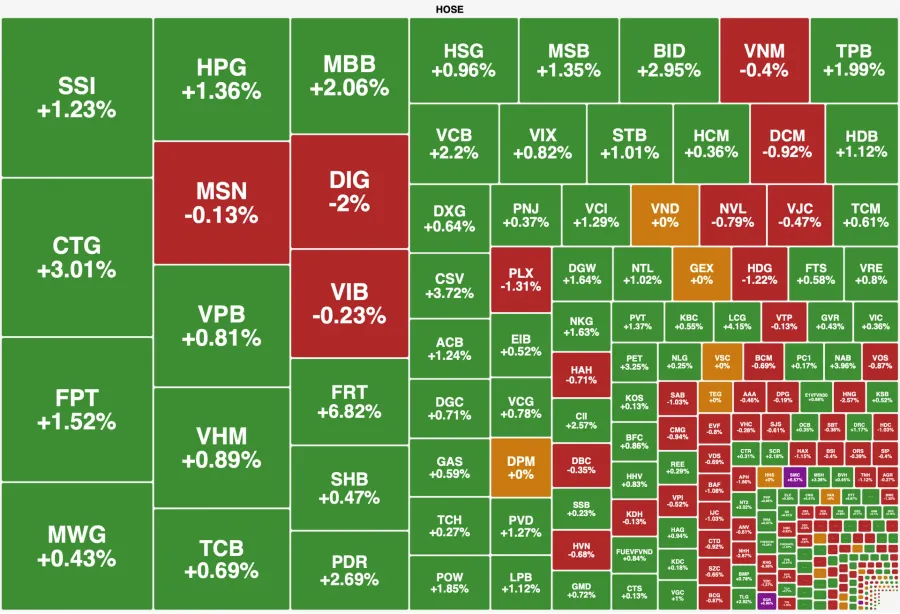
On the morning of April 8, 2026, Vietnam's stock market saw one of its most euphoric sessions of the year. Just hours after FTSE Russell officially confirmed Vietnam's upgrade to Secondary Emerging Market — an event eight years in the making — the VN-Index jumped 58.66 points (+3.50%) to 1,736.20, with 300 advancers and only 42 decliners. Morning HOSE liquidity exceeded VND 15,000 billion, sharply above the previous week's average.
But amid millions of retail buy orders, one person was preparing to hit sell. And it wasn't a random one.
When the whole market buys, one insider files to exit
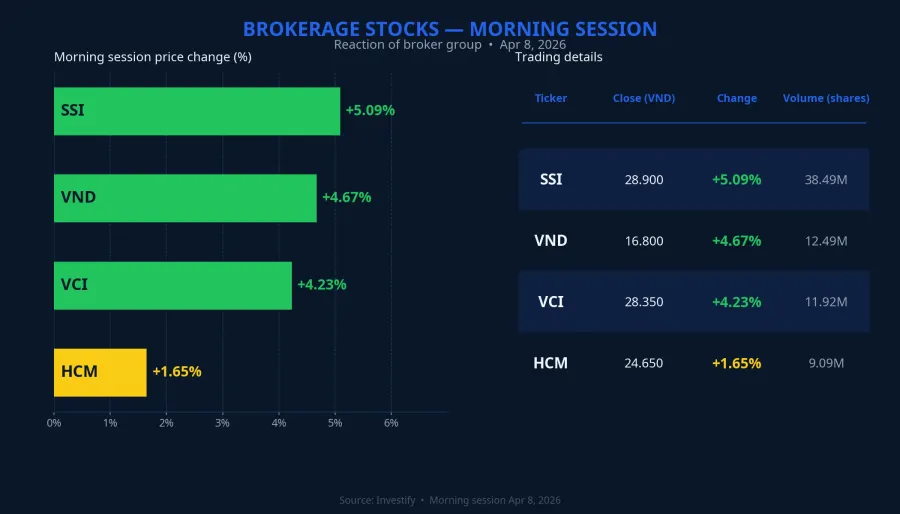
Brokerage stocks led the morning. They were also the group sitting at the top of every analyst's list of upgrade beneficiaries, with SSI Research estimating roughly USD 1.67 billion of ETF inflows into Vietnam. SSI rose 5.09%, VND rose 4.67%, and VCI rose 4.23% to VND 28,350 on volume nearly double the previous session.VnExpress
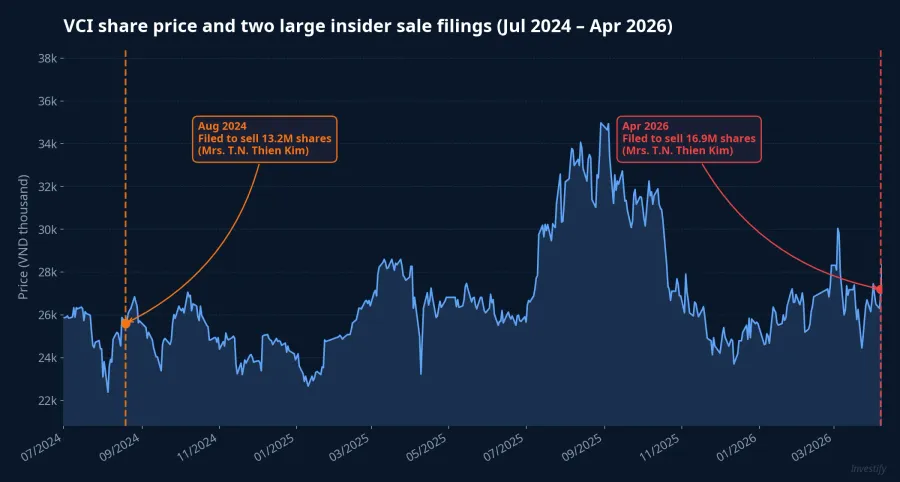
At the same moment VCI was jumping nearly 5%, an internal disclosure on the HOSE bulletin ran in the opposite direction of the market mood. Mrs. Truong Nguyen Thien Kim — wife of Vietcap Chairman To Hai, and the woman behind the Katinat and Phe La coffee chains and the Di Mai restaurant brand — registered to sell her entire 16.9 million VCI shares, equivalent to 1.47% of Vietcap's charter capital.CafeF
The VND 460 billion deal
According to the filing, the transaction will be executed via negotiated trades between April 13 and May 12, 2026, with the stated purpose of "addressing personal financial needs." At the April 7 closing price of VND 27,200, the block was worth around VND 460 billion.
That was the figure before the FTSE session. With the morning close on April 8 jumping to VND 28,350, the block is now worth roughly VND 479 billion. Put another way: in a single session, the FTSE catalyst added nearly VND 20 billion to Mrs. Kim's "exit reward" — more than the lifetime salary of an average bank employee.
After the trade, Mrs. Thien Kim will hold zero VCI shares. Her husband, Mr. To Hai, remains Vietcap's only large shareholder with a 15.19% stake, equivalent to over 129.1 million shares.

A repeat pattern: the VND 600 billion exit in 2024
This is not the first time Mrs. Thien Kim has unloaded a large VCI block right around a major catalyst. In August 2024, she registered to sell 13.2 million VCI shares and completed the transaction in September 2024, raising approximately VND 600 billion.Dan Tri
The 2024 sale came right after VCI had completed a bonus issue of more than 130 million shares — a major capital structure event. The 2026 sale comes precisely as FTSE Russell confirms the upgrade — the largest capital flow event in eight years. Two completely different events, with one thing in common: both were moments when the market was repricing the stock in a way that benefited the seller.
Adding the two together: in 20 months, Mrs. Truong Nguyen Thien Kim has (and will soon have) unloaded 30.1 million VCI shares, raising a total of more than VND 1,060 billion in cash from the very company her husband runs.
Why this insider trade deserves a closer read
Three reasons make this trade impossible to dismiss as "routine insider news."
First, the seller is in the best information position imaginable. As the wife of the Chairman of one of Vietnam's top five brokerages, Mrs. Kim sits about as close as one can get to the real read on the FTSE story — both the actual ETF inflow that may reach VCI, and the fair value of the stock after the news. When the person sitting next to the Chairman's dinner table chooses not to add but to exit entirely, that is a message that's hard to ignore.
Second, the timing matches the "expectation peak." Vietcap, alongside SSI, VND and HCM, is on virtually every report listing upgrade beneficiaries. This is supposed to be the moment insiders increase their position to ride the foreign inflows — not exit completely.
Third, the size is not small. 1.47% of charter capital is a significant block, especially when it comes from the Chairman's related parties — the very group Vietnam's Securities Law requires to disclose before trading, precisely to protect retail investors. The disclosure mechanism exists not to legitimize the trade, but to let retail investors read the signal. This time, the signal is reasonably clear.
Three principles for reading insider trades
How should retail investors read this? "Insider sells, so I sell" is too simple. But ignoring it is too easy.
Distinguish "personal" sells from "company" sells. "Addressing personal financial needs" is a common disclosure phrase and does not automatically mean "the company has a problem." But size and timing still say a lot: VND 460 billion is not a sum that an ordinary person needs to "personally address," and personal reasons rarely happen to coincide exactly with the FTSE confirmation session.
Look at the long-term pattern of the related-party group, not a single trade. One person selling can be a private matter. Multiple related parties selling within a short window is a signal worth taking seriously. Over the past 24 months, Vietcap's related-party group has had multiple disposals: a large personal one from Mrs. Kim, plus smaller tranches from Ban Viet Fund in late 2025 and March 2026.
Cross-check insider activity with retail sentiment. When insiders sell at the exact moment retail FOMO peaks, that's a classic short-term top warning. Vietnam's market history — the 2018 peak, the 2022 peak — shows that smart money tends to leave the table before the party ends. The signal is not always right, but its error rate is low enough that you shouldn't dismiss it.
What this means for investors during FTSE week
The FTSE upgrade story is real, the USD 1.67 billion ETF inflow estimate is real, and the brokerage sector's price reaction on April 8 is fully justified. The issue is not whether the story is right or wrong, but the gap between "the story is right" and "the price is fair." That gap is always measured in expectations — and expectations can run far ahead of reality before they correct.
Mrs. Thien Kim's VND 460 billion exit is not a verdict on brokerage stocks, and certainly not a reason to dump VCI in the afternoon session. It's just one data point. But it's a data point coming from the other side of the chessboard — from the person with the best information, choosing to leave the table at the exact moment the crowd is fighting to sit down.
The choice still belongs to each investor. But before chasing VCI at the VND 28,000 level, perhaps it's worth asking a simple question: at this chessboard, whose side are you sitting on?