

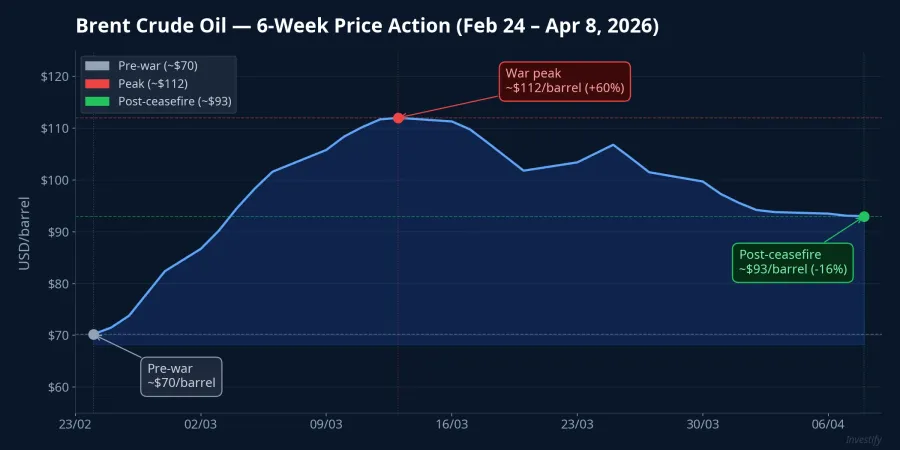
The big picture reveals a sudden shift: on the evening of April 7 (US time), President Trump announced a two-week ceasefire with Iran, brokered by Pakistan. Iran accepted and committed to reopening the Strait of Hormuz under coordination by Iranian military forces. Brent crude immediately plunged roughly 16%, from the $110 range down to approximately $93 per barrel, the largest single-session drop since the 1991 Gulf War.NBC News
Capital flows are shifting visibly across global markets: Dow futures surged 930 points (+2%), while S&P 500 futures rose 2.2%.NBC News Asian markets are expected to open in the green. But the question for Vietnamese investors isn't just about today's color — it's about the medium-term consequences of this oil price shock.
Context: The energy crisis weighing on Vietnam
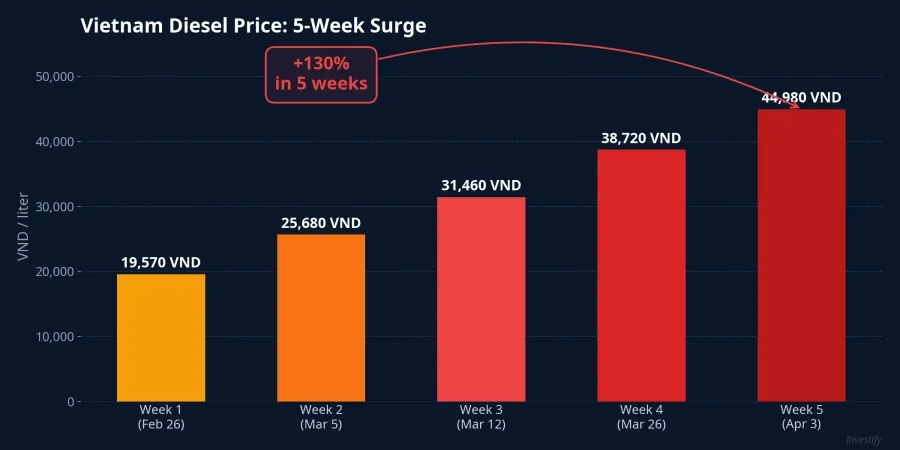
Before analyzing opportunities, it's essential to understand the damage the US-Iran oil crisis has already inflicted on Vietnam's economy. Brent rose from approximately $70.77 per barrel in late February to $110.19 on April 7, a 55.7% surge in just five weeks. The transmission was rapid: domestic diesel prices jumped from 19,570 VND/liter on February 26 to 44,980 VND/liter on April 3, a nearly 130% increase over the same period. E5 RON92 gasoline also rose from 19,520 VND/liter to 25,420 VND/liter, a 30% increase.
March CPI hit a five-year high of 4.65%, driven primarily by energy costs. Airlines were forced to cut thousands of flights starting in April due to surging jet fuel prices.Thanh Niên Does last night's oil price shock truly relieve all of these pressures? Here are five things investors need to understand before this morning's trading session.
1. Aviation: positive signals, but don't expect immediate recovery
Jet A-1 fuel prices are closely correlated with crude oil. With Brent dropping from $110 to $93, Jet A-1 could decline by $15-20 per barrel. This is good news for VJC (trading at 163,500 VND) and HVN (21,400 VND).

However, investors should note three things. First, airlines already implemented major capacity cuts in early April across domestic and international routes; restoration requires time due to scheduling, staffing, and fuel supply logistics. Second, the Ministry of Industry and Trade has only guaranteed fuel supply through the end of April, and Hormuz is conditionally open under Iranian military coordination, not full freedom of navigation.VTV Third, VJC already recovered from 155,000 VND (March 26) to 163,500 VND (April 7), a 5.5% gain on prior expectations; today's session may continue the rally, but watch for resistance if the stock gaps up significantly at open.
2. Domestic fuel prices: the next adjustment could bring significant relief
Under the current fuel price adjustment mechanism, retail prices are adjusted weekly on Fridays, with an emergency mechanism triggered when the base price changes by ≥15% (increase) or ≥10% (decrease) versus the previous period.Thư Viện Pháp Luật
The most recent adjustment was on April 3. If Brent holds in the $90-95 range for the next few days (roughly a 15% decline from $110), the base price for diesel and gasoline could fall substantially, triggering either an emergency adjustment or a reduction in this Friday's regular cycle (April 10-11). Diesel currently sits at 44,980 VND/liter; if oil maintains its decline, the next adjustment could bring diesel down by 3,000-5,000 VND/liter, providing some relief for transportation and logistics costs.
That said, retail prices don't decline at the same rate as crude because they also include the price stabilization fund (currently in deep deficit), environmental protection taxes, and fixed business costs. Don't expect a 16% diesel cut just because Brent fell 16%.
3. Inflation: easing pressure, but with a 1-2 month lag
March CPI at 4.65% is a concerning figure, but if oil prices remain below $100 per barrel, the CPI outlook for April should be less tense. Transportation costs will decline with diesel prices, retail gasoline prices will adjust downward, and the high base effect from March creates a more favorable comparison basis.
However, the transmission from global oil prices to Vietnam's CPI carries a 1-2 month lag. Diesel price reductions this week will affect freight transportation costs in 2-4 weeks and only show up in the May or June CPI reading. If inflation cools, pressure to raise interest rates will diminish, benefiting equities broadly, especially real estate and banking stocks. But the ceasefire is only two weeks; everything could reverse if negotiations collapse.
4. Oil and gas stocks: clear divergence
The last time the market witnessed a similar oil price plunge was in 2020. The lesson then was that not all oil and gas stocks face equal pressure.
Directly pressured group: PVD (32,250 VND) faces risk as rig rental rates are directly tied to oil prices; exploration demand could be cut if Brent continues falling. PVD has already dropped 9.8% from 35,750 VND (March 27) to 32,250 VND (April 7). BSR (25,150 VND) faces inventory risk from high-cost crude; if it purchased crude at $110 and refined product prices fall with Brent, the crack spread gets squeezed. BSR has fallen 13.7% from its peak of 29,150 VND (March 30).
Less affected group: PLX (38,600 VND) is a distributor that benefits from distribution margins when prices stabilize rather than when they swing wildly. PLX declined more modestly at -8.6% from its peak of 42,250 VND (March 27).
The advice here is straightforward: don't panic-sell oil and gas stocks during a price shock. Markets tend to overreact in the short term, and if the ceasefire collapses, Brent could snap back above $110 very quickly.
5. The biggest risk: the ceasefire is only 2 weeks

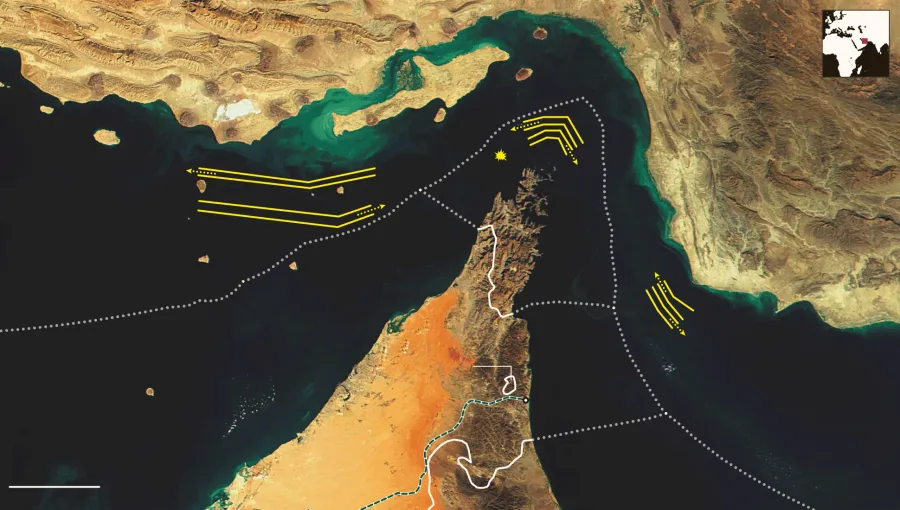
This is the most important takeaway. The ceasefire agreement has three core instabilities. First, it's only a two-week pause, not permanent peace; if negotiations don't progress, conflict could reignite. Second, the Strait of Hormuz is conditionally open: Iran only allows vessels through under its military coordination, meaning Tehran retains control and could shut it down at any moment.NBC News Third, Brent at $93 is still 31% above the pre-war level of $70.77; the market continues to price in significant risk.
Final thoughts: seize the opportunity but keep a contingency plan
The big picture shows this is positive short-term news for Vietnam's economy: reduced transportation cost pressure, the prospect of lower domestic fuel prices, and diminished inflation anxiety. However, smart investors will act on principle: capitalize on short-term opportunities while maintaining adequate cash reserves.
Three common mistakes to avoid in today's session: (1) getting overly optimistic by loading up on aviation stocks when oil has only been down for a few hours; (2) panic-selling oil and gas on reflex when BSR and PVD could bounce hard if the ceasefire fails; (3) forgetting that Brent at $93 is still 50% above the start of the year (around $60.75 on January 2). The energy crisis isn't over; it's just temporarily cooling.
Capital flows are shifting, but remember: a two-week ceasefire is not the same as peace.