
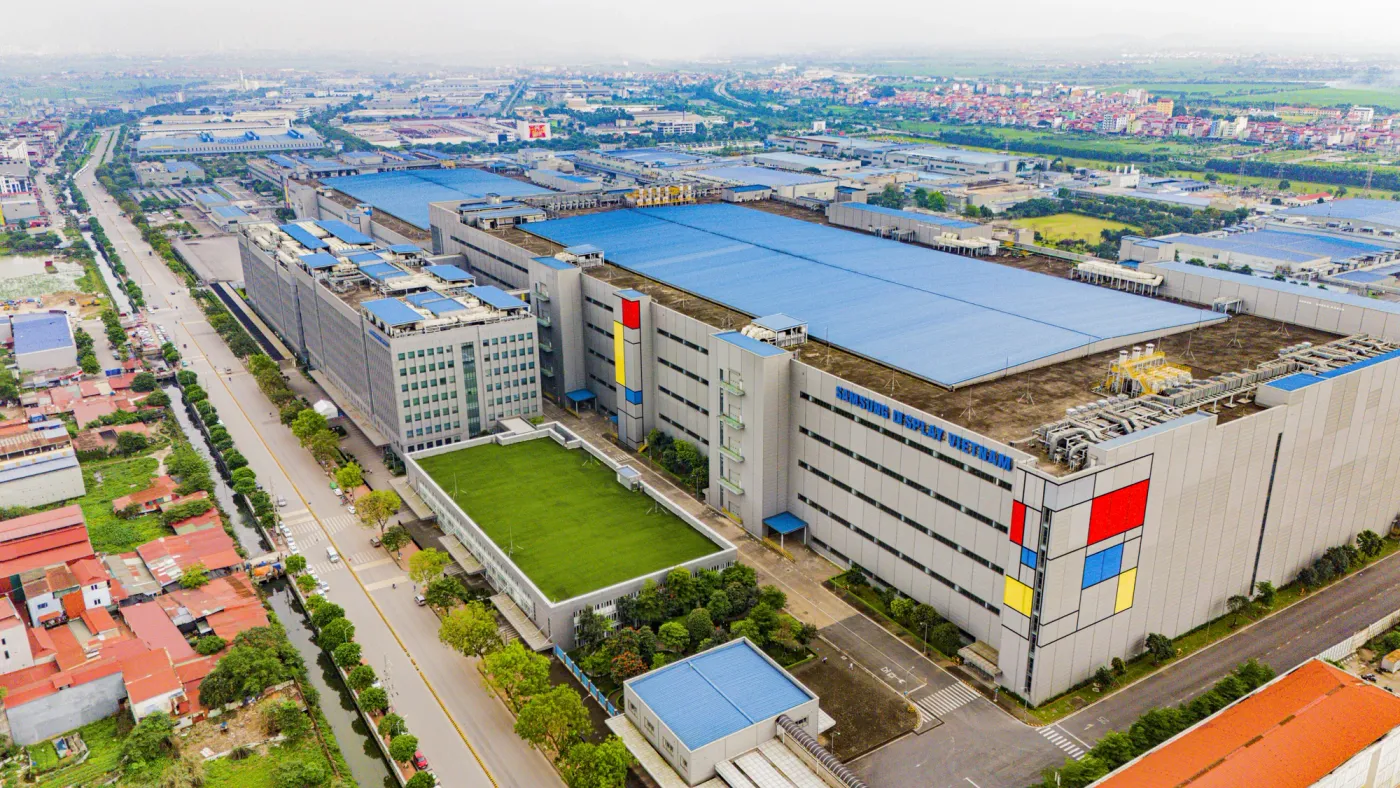

The big picture reveals a rare signal: the four largest Korean conglomerates are simultaneously sending their top leaders to Vietnam in a single wave. Not one, not two, but all four chaebols have placed Vietnam at the top of their strategic priority list. Capital flows are shifting, and the stock market reacted immediately during the April 8 session.
200 Korean Companies Heading to Vietnam
In April 2026, the Federation of Korean Industries (FKI) and the Korea Chamber of Commerce and Industry (KCCI) are organizing large-scale business delegations to Vietnam, each comprising approximately 200 companies.VietnamPlus The most notable aspect is the direct participation of the top leaders of the four largest chaebols: Samsung Electronics Chairman Lee Jae-yong, SK Group Chairman Chey Tae-won, Hyundai Motor Chairman Chung Euisun, and LG Chairman Koo Kwang-mo.Znews
This is a rare occasion where all four major chaebols send their top executives to Vietnam simultaneously. The visit comes as Vietnam has just been confirmed by FTSE Russell for an upgrade to Secondary Emerging Market status (effective September 2026), the VN-Index surged 79.01 points to 1,756.55 points on April 8, and Korean FDI continues to lead all foreign investment in Vietnam. Against the backdrop of global supply chain risks and rising trade protectionism, the chaebols are accelerating their production diversification strategy toward ASEAN, with Vietnam as their top choice.
Korea Leads FDI with 37.8% of Registered Capital
South Korea is currently the largest foreign investor in Vietnam. In the first two months of 2026, Korea led in registered capital with $1.34 billion, accounting for 37.8% of total newly registered capital.Báo Lào Cai Total FDI disbursement reached $3.21 billion during the same period, up 8.8% year-over-year, marking the highest level in five years.TTTCTT
Approximately 73% of FDI capital is concentrated in processing and manufacturing. This structure perfectly aligns with chaebol investment strategies: Samsung focuses on electronics and semiconductors, LG on displays and components, Hyundai on automobiles and shipbuilding, and SK on energy and technology. In other words, Korean capital is not only large in volume but is flowing precisely into the sectors Vietnam needs most.
Samsung: $65 Billion in Revenue and a Move into Semiconductors
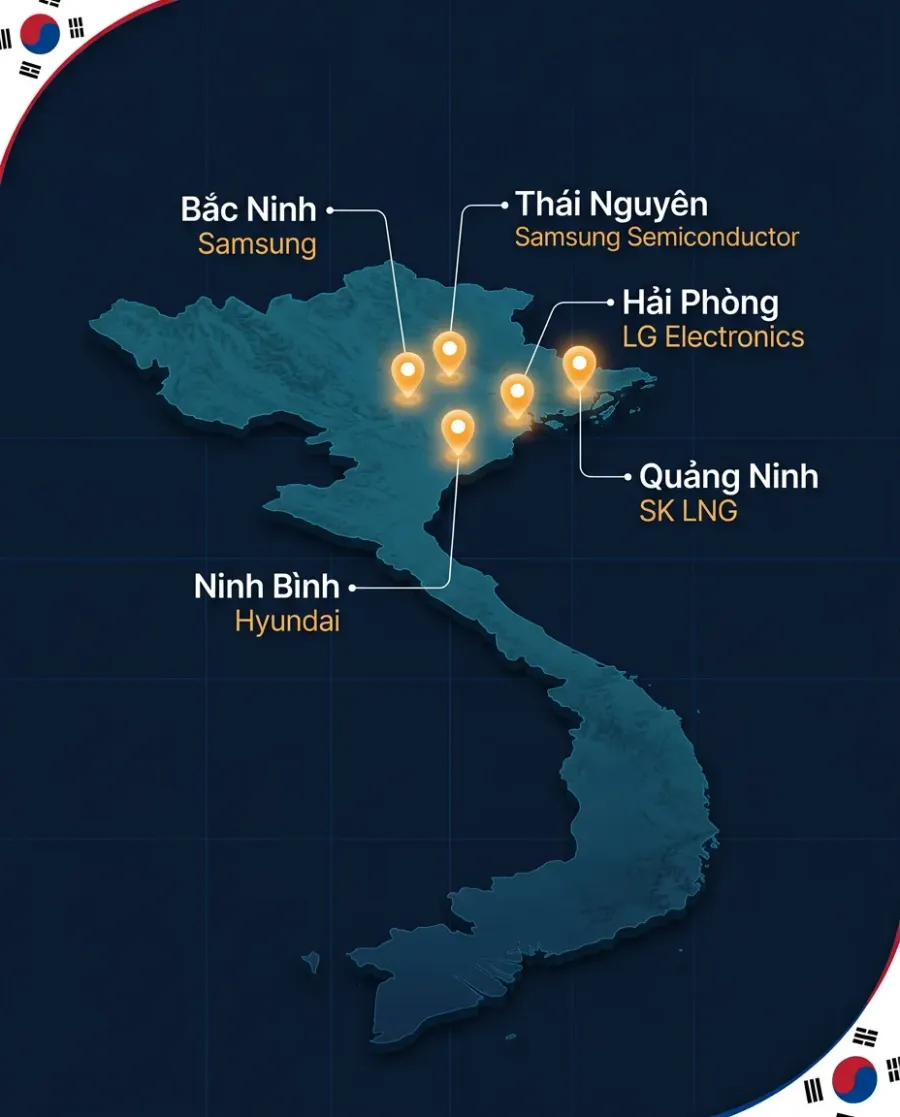
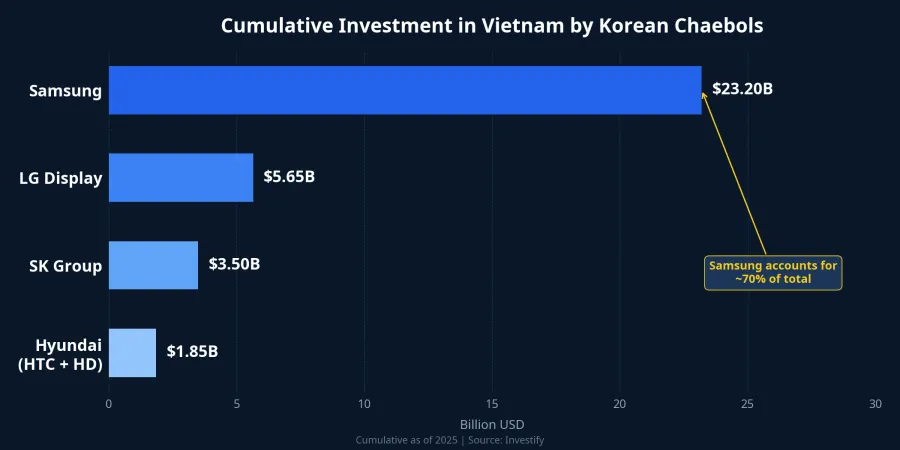
Samsung is the largest foreign investor in Vietnam with cumulative investment of approximately $23.2 billion. In 2025, its 6 "core" factories in Vietnam recorded revenue of $65 billion, up 8% year-over-year, with profits reaching $3.53 billion.CafeFVnEconomy
The biggest turning point is the establishment of Samsung Vietnam Semiconductors (SVS) on March 13, 2026, located in Yen Binh Industrial Park, Thai Nguyen, with charter capital of $100 million.DFF SVS will focus on semiconductor packaging and testing, officially positioning Vietnam in the global chip value chain. This is not just another factory; it signals Samsung's repositioning of Vietnam from an "assembly hub" to a "semiconductor link."
Samsung's ecosystem in Vietnam currently includes 6 factories spanning from Bac Ninh and Thai Nguyen to Ho Chi Minh City, with a network of 306 Vietnamese supplier companies and a localization rate of 35%.
SK, LG, Hyundai: The Three Remaining Pillars
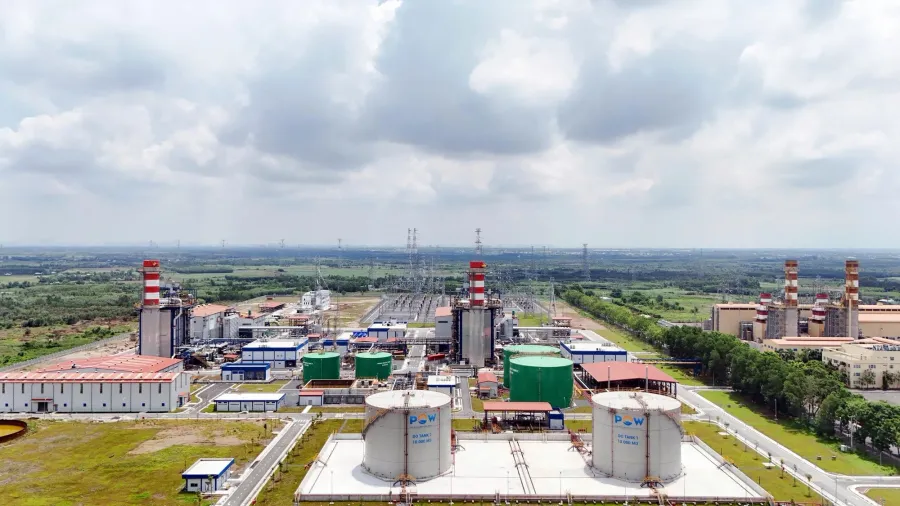
SK Group currently has total investment of approximately $3.5 billion in Vietnam, but its biggest ambition lies in massive LNG power projects. The Quang Ninh LNG project features a 1,500 MW power plant in Cua Ong with total investment of approximately $2.2 billion, with Quang Ninh having completed land clearance of nearly 34 hectares.Báo Quảng NinhBáo Lâm Đồng The Quynh Lap LNG project (Nghe An) has a scale of $2.11 billion and capacity of 1,500 MW, targeting operation before 2030.Vietnam.vn Combined, the LNG segment alone is more than double SK's current total investment in Vietnam.
LG Display in Hai Phong has raised its total investment to $5.65 billion following a $1 billion capital increase approved in late 2024.VnEconomy The factory produces an average of approximately 14 million OLED panels per month, making it LG's largest display production hub globally outside South Korea, employing over 22,000 workers. LG Display plans to hire approximately 2,600 additional workers in 2026, clearly signaling continued capacity expansion.
Hyundai operates through two segments: the Hyundai Thanh Cong joint venture runs 2 factories in Ninh Binh with total capacity of 180,000 vehicles per year, selling over 67,100 vehicles in 2024, ranking second in the market.CafeF The shipbuilding arm, HD Hyundai Vietnam in Khanh Hoa, is expanding with total capital exceeding $351 million, planning to build 17 new ships in 2026 with estimated revenue of $691 million.Nhà Đầu TưNhà Đầu Tư
Which Stocks Catch the Korean FDI Wave?
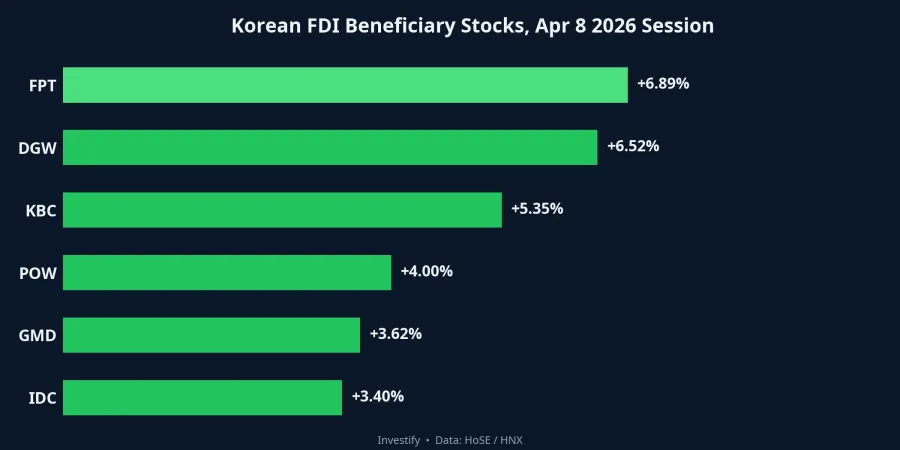
Capital flows are shifting from expectations to action. During the April 8 session, stocks benefiting from Korean FDI rallied broadly, with FPT leading with a 6.89% gain to VND 79,100.
Industrial park stocks are the frontline beneficiaries. KBC (Kinh Bac) rose 5.35% to VND 33,450 thanks to its land bank in Bac Ninh and Hai Phong, the two largest production centers for Samsung and LG. IDC (IDICO) gained 3.40% to VND 48,600 with land in Dong Nai and Ba Ria-Vung Tau serving southern expansion needs. SZC (Sonadezi Chau Duc) rose 3.98% to VND 28,750, and PHR (Phuoc Hoa Rubber) gained 3.80% to VND 62,800 on rubber land conversion to industrial parks in Binh Duong.
Technology supply chain stocks also responded positively. FPT surged 6.89% to VND 79,100, benefiting from digital transformation and AI demand from Korean conglomerates. DGW (Dien Quang World) gained 6.52% to VND 45,750 as Samsung's official distributor in Vietnam.
Energy stocks caught the LNG wave: POW (PV Power) rose 4.00% to VND 13,000 as a potential partner in LNG power projects. PVS (PV Technical Services) gained 2.14% to VND 38,200 on its EPC capabilities for LNG infrastructure. GMD (Gemadept) rose 3.62% to VND 74,500, directly benefiting from increased electronics component exports.
Risks to Consider
Despite the positive outlook, investors should note several factors. First, licensing and land clearance processes at industrial parks can be lengthy, delaying actual FDI disbursement. Second, U.S.-China trade tensions and Section 301 investigations may impact the electronics supply chain through Vietnam.
Third, SK's LNG projects are still in the gas price negotiation and planning approval phase, and timelines could be significantly delayed. Finally, expectations have already been partially priced in: KBC rose from the VND 27,000 range in late March to VND 33,450, a gain of approximately 24% in just two weeks. Investors need to clearly distinguish between long-term prospects and short-term expectations that have already run ahead.
FTSE Upgrade Plus Korean FDI: A Double Leverage Effect
The Korean business delegation's visit coincides precisely with Vietnam's FTSE Russell upgrade, creating a double leverage effect on capital flows. The FTSE upgrade will attract passive ETF capital estimated at billions of dollars, while new investment commitments from chaebols boost direct FDI inflows. Both capital streams are directed toward infrastructure, technology, and industrial park stocks.
With South Korea accounting for 37.8% of registered FDI in the first two months and all four major chaebols simultaneously accelerating expansion, this could mark the beginning of a new investment cycle in Vietnam. The focus of this cycle: semiconductors, clean energy, and high technology. Investors should closely monitor actual disbursement progress and project approval decisions in Q2-Q3 2026 to assess whether expectations will translate into reality.