
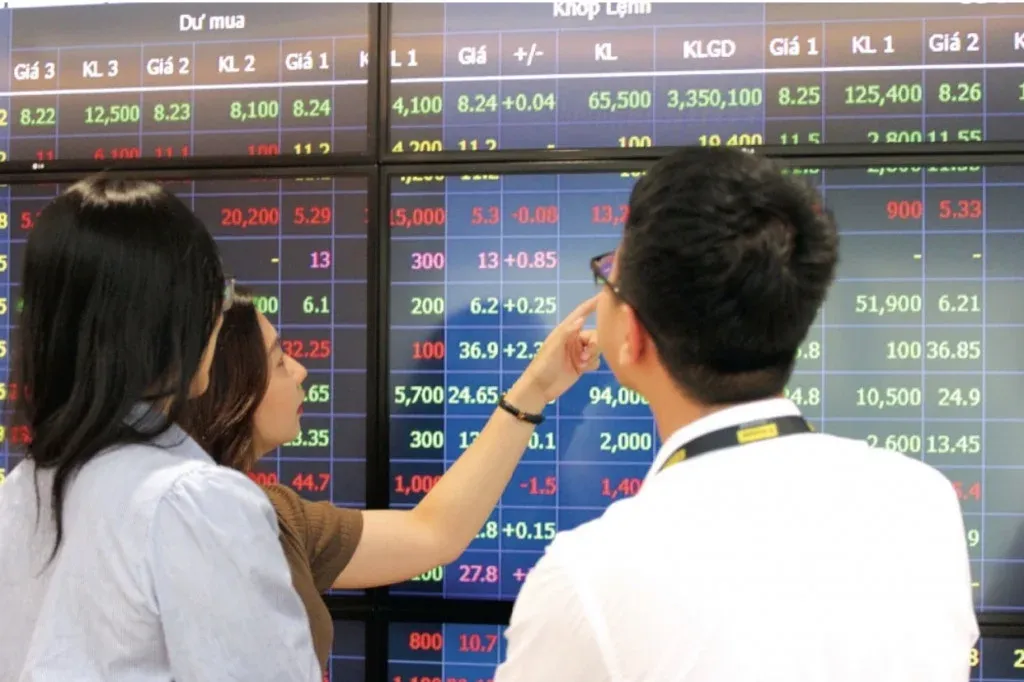

The big picture reveals a rare paradox: in Q1/2026, foreign capital withdrew at record intensity, yet domestic retail investors flooded into the market at an unprecedented pace of account openings. This isn't the first time these two capital flows have moved in opposite directions, and history offers very clear lessons.
VN-Index Q1/2026: A 16.4% Plunge Then Recovery
The VN-Index closed Q1 around 1,674 points, down 6.16% from the 1,784-point level at the end of 2025. However, the quarter-end figure doesn't capture the full extent of volatility: the index touched a peak of 1,903 points on January 13 before plunging 16.4% to a trough of 1,591 points on March 23. On April 7, the VN-Index closed at 1,677.54 points, up a modest 0.15% amid persistently low trading volume.
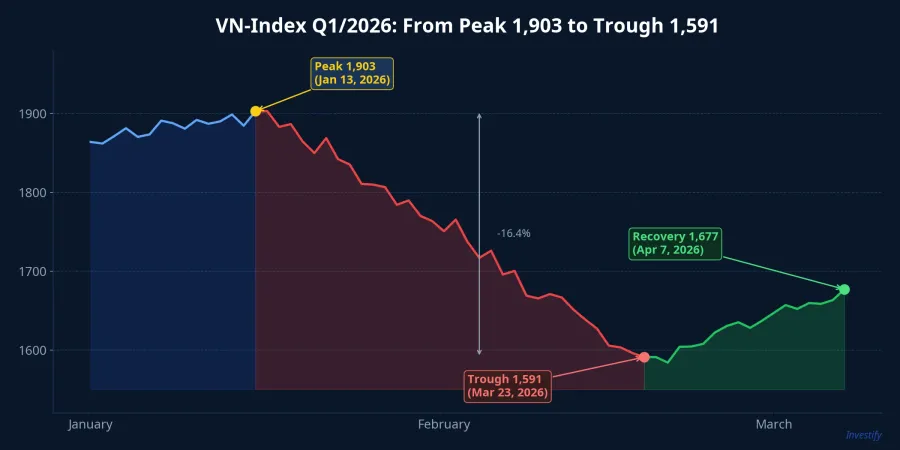
This selloff unfolded against a backdrop of escalating Iran–US geopolitical tensions, a strengthening US dollar, and increasingly intense net selling pressure from foreign investors. But it was precisely this deep decline that triggered powerful bottom-fishing sentiment from domestic investors.
Foreign Net Selling Hits Record: Over 30,000 Billion VND
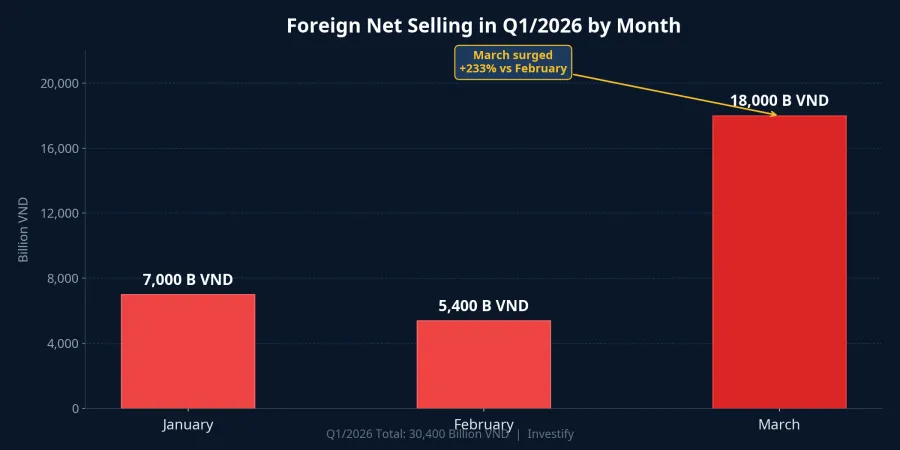
On the HOSE exchange, foreign investors net sold nearly 30,400 billion VND in Q1/2026, up 17.4% from 25,900 billion VND in the same period of 2025.Tạp chí KTTC Including all three exchanges, the net selling value exceeded 32,000 billion VND.Người Quan Sát
March was the epicenter: foreigners dumped nearly 18,000 billion VND on HOSE alone, accounting for more than half the quarter's total, with 18 out of 22 sessions seeing net selling.DNSE
Blue-Chips Bear the Heaviest Pressure
Leading the March net selling list was VIC (Vingroup) at 4,860 billion VND, followed by FPT (2,554 billion), STB (2,505 billion), VHM (1,901 billion), and the FUEVFVND ETF certificate (1,728 billion). Major banks VCB and BID also ranked among the top net sold.DNSE
Going against the trend, MWG (Mobile World) saw net buying of 1,479 billion VND, along with DCM (965 billion) and MCH (920 billion). Notably, on the HNX exchange, foreigners actually net bought over 647 billion VND, marking the second consecutive month of net buying.Tạp chí KTTC This suggests the selling is selective, not a wholesale capital exodus.
Three Structural Reasons
Capital flows are shifting for three main reasons. First, passive ETF funds are rebalancing portfolios: FUEVFVND alone saw nearly 1,728 billion VND in redemptions during March. Second, a strong US dollar and elevated US interest rates are pulling capital back to developed markets; this is a global emerging market trend, not unique to Vietnam. Third, geopolitical risks from Iran–US tensions and USD/VND exchange rate pressure are prompting foreigners to de-risk.
Retail Investors: 600,000 New Accounts Amid the Selling Storm
While foreign investors retreated, domestic retail investors showed remarkable enthusiasm. January 2026 saw 244,700 new accounts opened, bringing the total past 12.07 million.Thời báo TCVN February dipped slightly to 198,000 accounts due to the Lunar New Year holiday.Thời báo TCVN In March, even as the VN-Index tumbled from 1,713 to 1,591 points, another 157,000 accounts were opened.VnEconomy
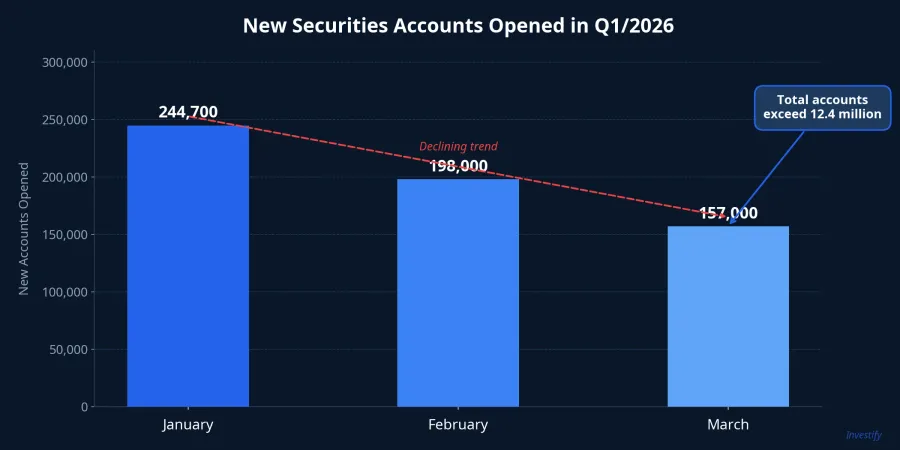
For the full quarter, the market welcomed approximately 600,000 new accounts, pushing the total beyond 12.4 million. Compared to end-2025 when total accounts stood at nearly 11.9 million, the growth rate is clearly accelerating.CafeF
Average daily trading value on HOSE in March reached approximately 18,175 billion VND per session, up 44.4% from the prior 5-month average and the highest level in 10 months.VnEconomy This suggests retail capital isn't just flowing in on FOMO; many investors assessed the market as cheap enough to bottom-fish, with numerous blue-chips trading below their 5-year average P/E.
History: Three Times Foreigners Sold, Three Times the Market Recovered
The last time this happened wasn't once but three times, and each followed a similar script.
2018: The VN-Index peaked at 1,211 points in April, then plunged 27% to a trough of 888 points in October amid the US–China trade war.VietnamNet Foreigners net sold heavily for months, yet 12 months after the trough, the VN-Index recovered to around 1,000 points, up 13%.
2022: The VN-Index collapsed from its all-time high of 1,528 points to a trough of 874 points, losing 43% of its value as the Fed hiked rates aggressively.Finhay But 12 months later, the index recovered to around 1,250 points, gaining 43% from the trough.
2024: Foreigners net sold a record 90,000+ billion VND on HOSE, yet the VN-Index still gained 12.11% for the year, powered by domestic capital flows.VnEconomy
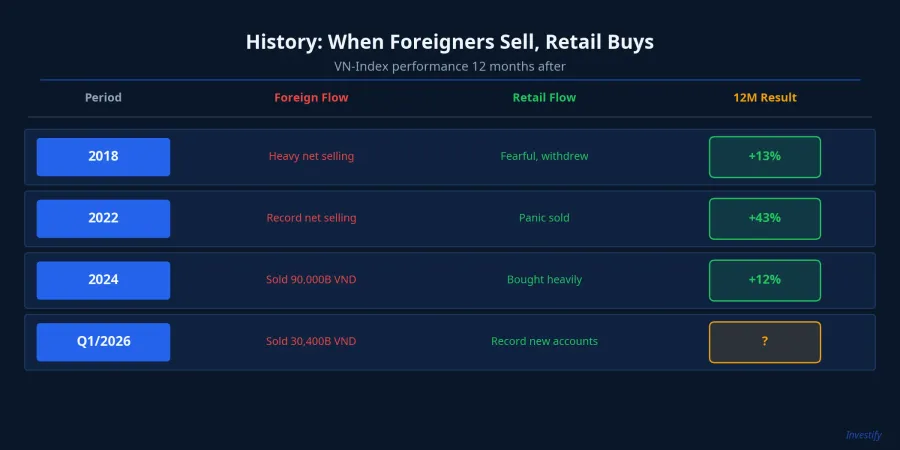
The historical pattern is clear: foreigners typically sell for structural reasons (fund rebalancing, EM capital withdrawal, allocation adjustments) rather than necessarily being bearish on Vietnam's outlook. Meanwhile, Vietnamese retail investors tend to get the direction right but the timing wrong.
Q1/2026: Which Factors Tip the Scale?
On the side supporting retail investors, there are three strong pillars. Q1/2026 GDP grew 7.83%, the highest in 15 years, showing the real economy remains robust.Báo Chính phủ FTSE Russell will officially upgrade Vietnam to secondary emerging market status starting September 2026, expected to attract over $1 billion in passive capital.VnEconomy Additionally, March's 10-month-high liquidity shows real money flowing into the market.
However, the warning signs also carry weight. Of the 12.4 million accounts, only about 20–30% actively trade; many accounts go dormant after opening. Macro risks from Iran tensions, US recession fears, and exchange rate pressure persist. More importantly, foreigners show no signs of reversing: selling pressure continued in early April sessions.
Five Steps for Investors Considering Entry
If you're among the 600,000 new account holders considering deploying capital, keep five principles in mind. First, never go "all-in" at once: split your capital into 3–4 tranches, spaced 2–4 weeks apart, so you still have ammunition if the market continues falling. Second, prioritize stocks with real cash flows and earnings growth; avoid speculative names that only rise on momentum. Third, set a clear 7–10% stop-loss threshold because "bottom fishing" can easily become "catching a falling knife." Fourth, monitor foreign flow signals: when they shift to net buying, it's typically a more reliable confirmation of a bottom. Finally, diversify your portfolio: consider allocating a portion to government bonds, bank deposits (12-month rates currently at 5–8% depending on the bank), or gold as a safety cushion.
Conclusion
The divergence between foreign and retail investors in Q1/2026 is not unprecedented. Foreigners sell for their own reasons: fund restructuring, EM capital withdrawal; not because they "know something" that Vietnamese investors don't. Conversely, retail investors rushing to bottom-fish also have solid foundations: strong GDP, FTSE upgrade approaching, and attractive valuations.
The key lies in discipline and capital allocation. History shows that those who remain patient, deploy capital gradually, and select quality stocks during deep market declines are typically rewarded handsomely after 12 months. The question isn't "who's right" but "how are you prepared for both scenarios."