

The big picture reveals something deeply concerning: when three of the most influential voices in the global financial system speak up within 24 hours, it's no longer a coincidence. It's a signal.
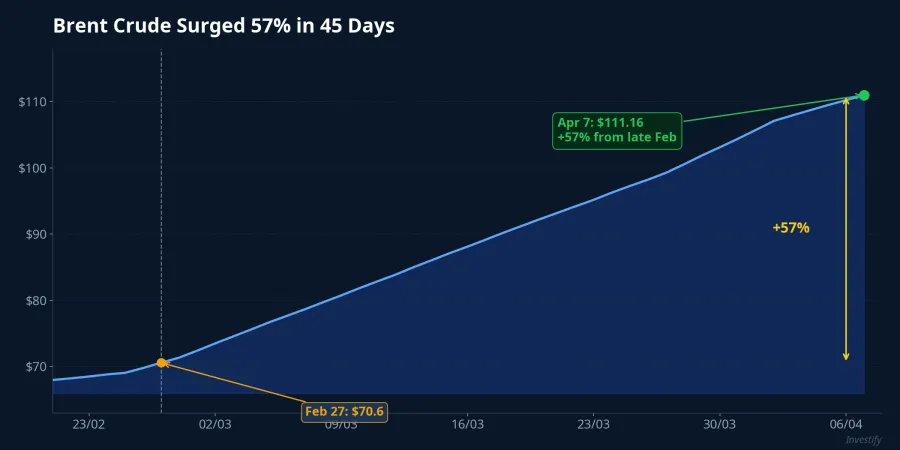
From April 6 to 7, 2026, Fed Cleveland President Beth Hammack opened the door to rate hikes, JPMorgan CEO Jamie Dimon warned of stagflation in his annual shareholder letter, and IMF Managing Director Kristalina Georgieva urged preparation for "unthinkable" scenarios. All three warnings converge on a single trigger: Brent crude has surged to $111.16 per barrel, up roughly 57% from $70.77 per barrel in late February — before the Iran military conflict escalated.
The Fed opens the door to rate hikes

On April 6, Beth Hammack — President of the Federal Reserve Bank of Cleveland — stated that if inflation continues to exceed the 2% target, raising interest rates is entirely possible. She noted that rising gas prices driven by the Iran war are "the No. 1 thing" she hears from people in her district, which covers Ohio and parts of Pennsylvania, West Virginia, and Kentucky.ABC News
More notably, the Cleveland Fed's forecasting model shows U.S. inflation could reach 3.5% in April 2026, the highest since 2024. This is the clearest signal yet from a Fed official that rate cuts are being pushed back indefinitely, replaced by the opposite scenario: rate hikes.ABC News
Capital flows are shifting direction in the derivatives market. For the first time in 2026, futures markets are pricing in a probability exceeding 52% that the Fed will raise rates at least once before year-end. This is a major reversal from the rate-cut expectations that dominated since the start of the year.CNBC The federal funds rate remains at 4.25%-4.50% since December 2024, and the "higher for longer" outlook is becoming increasingly clear.
Jamie Dimon: "The skunk at the garden party"
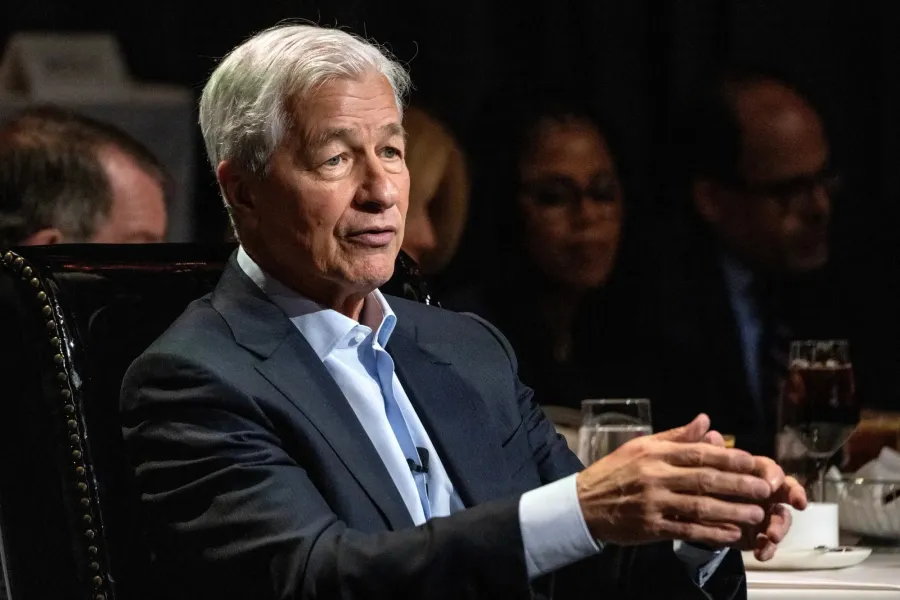
On the same day, Jamie Dimon released his annual 2026 shareholder letter, widely regarded as the most pessimistic assessment of his career.Fortune Dimon used the striking metaphor of "the skunk at the garden party" to describe a scenario where inflation gradually creeps upward instead of cooling down:
"The skunk at the garden party — and it could show up in 2026 — is the scenario where inflation slowly rises, instead of slowly falling. This alone could cause interest rates to rise and asset prices to fall."
The last time something similar happened was in the 1970s, when the oil shock pushed the U.S. economy into prolonged stagflation. Dimon identified the Iran war as the top risk to global stability, surpassing even the Ukraine conflict and tensions with China. He warned that the war creates a "persistent energy shock," disrupting supply chains and potentially pushing the global economy into slow growth combined with high inflation.CNN
Dimon also warned that asset prices are at "very high" levels and that markets are complacent about recession risks. Credit conditions are deteriorating while global manufacturing could weaken significantly if tensions persist.MarketMinute
IMF urges preparation for "unthinkable" scenarios
IMF Managing Director Kristalina Georgieva previously called on global policymakers to prepare for "unthinkable" scenarios due to the prolonged Middle East conflict.Bloomberg The IMF's assessment was blunt: "While war affects the global economy in many different ways, all paths lead to higher prices and slower growth."Al-Monitor
Before the conflict, the IMF had forecast global inflation to decline to 3.7% in 2026 with stable growth around 3.3%. Now, the European Central Bank (ECB) has warned that a prolonged conflict could push energy-dependent economies like Germany and Italy into a technical recession by late 2026. Georgieva emphasized that governments and central banks now have less policy room than in previous crises to support their economies if a new shock hits.Bloomberg
Oil prices: the trigger that unites all risks
All three signals converge on a single variable: oil prices. Brent at $111.16 per barrel creates a self-reinforcing spiral that every investor needs to understand. Rising inflation forces the Fed to maintain or raise rates; higher production costs squeeze corporate margins; declining purchasing power weakens consumption; and capital flight from emerging markets pressures exchange rates and stock markets.
In Vietnam, the impact is already visible: E5 RON92 gasoline stands at 25,420 VND per liter as of April 3, while the USD/VND exchange rate hovers around 26,331 VND. The exchange rate hasn't moved sharply yet, but if the Fed actually raises rates, the State Bank of Vietnam will face a dual dilemma: either raise rates in tandem to defend the currency, or accept VND depreciation. Both scenarios negatively impact the stock market.
VN-Index on April 7: slight gain, sharp volume drop
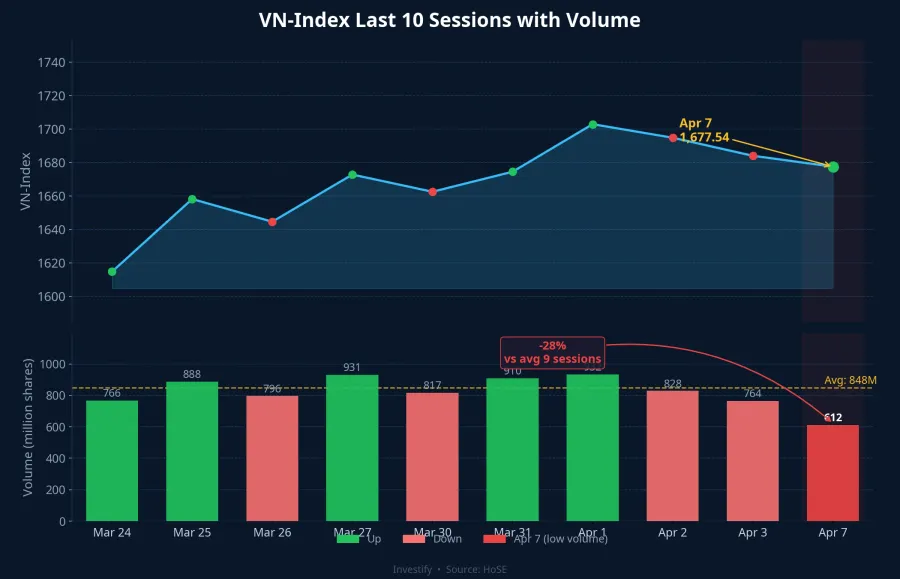
On April 7, the VN-Index closed at 1,677.54 points, up a modest 0.15%. The number seems calm, but the real story lies in trading volume: only 612 million shares changed hands, down roughly 28% from the average of the previous 9 sessions. The number of advancing stocks (167) and declining stocks (147) were nearly equal, indicating a market in wait-and-see mode.
S&P 500 futures fell 0.51% ahead of the Iran deadline, while the Dow Jones closed at 46,669.88 points, up 0.4% on April 7 on hopes of a last-minute ceasefire deal.CNBC The divergence between the Dow's slight gain and falling S&P 500 futures reveals a market deeply uncertain at the threshold of the deadline.
Hormuz deadline: three scenarios for April 8
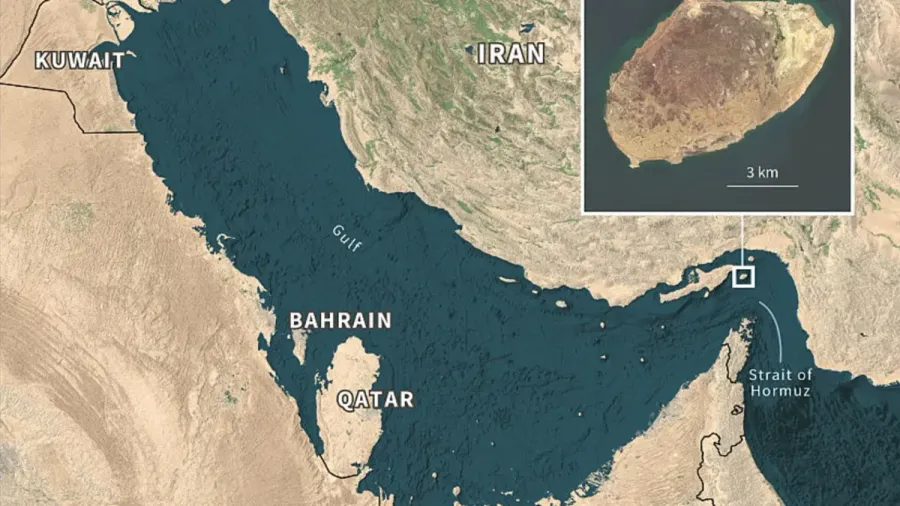
President Trump set a deadline of 8 PM ET on April 7 — approximately 7 AM on April 8, Vietnam time — demanding that Iran reopen the Strait of Hormuz. Trump declared Iran would "live in hell" if it fails to comply.Benzinga
The result will be known before the Vietnam market opens on April 8, creating three possible scenarios:
Positive scenario: ceasefire agreement or Iran concession. Oil prices could drop 10-15% rapidly, and the VN-Index would react positively. Transportation, retail, and real estate stocks would benefit, though oil and gas stocks would face correction pressure.
Neutral scenario: deadline extension or continued negotiations. The market continues to fluctuate in a narrow range with low volume. There are positive signals from the "Islamabad Accord" discussions being mentioned.MarketMinute
Negative scenario: military escalation. Oil prices could surge past $120-130 per barrel, creating a shock across all markets. The VN-Index could drop 2-3% in a single session, with systemic risk overwhelming all sector-specific factors.
Stock sectors to watch
In an environment of high interest rates combined with rising oil prices, the divergence between sectors will be stark. Potential beneficiaries include oil and gas (upstream and services benefit directly from high oil prices, though reversal risk is significant if a ceasefire is reached), banks with high NIM (large CASA ratios benefit from widening interest rate spreads), insurance (improved investment yields), and companies with strong cash flow and low debt.
Conversely, the hardest-hit groups include real estate (higher borrowing costs, weak demand), securities firms (margin squeeze), transportation and logistics (fuel costs eat directly into margins), capital-intensive businesses (heavy industry, aviation, construction materials), and non-essential consumer retail.
Defensive strategy for investors
In the short term (1-2 weeks), the top priority is to increase cash allocation to 30-50% of the portfolio and absolutely avoid using margin. Investors should refrain from bottom-fishing in sensitive sectors like real estate, securities, and transportation until clear signals emerge from the Hormuz deadline. Monitoring the outcome on the morning of April 8 before placing any orders is an essential prerequisite.
In the medium term (1-3 months), prioritize stocks with stable cash flows: large banks with high CASA ratios and exporters benefiting from a strong USD. Savings interest rates for 12-month terms are currently attractive at 5-5.5% at Big4 banks and 7-8% at smaller/online banks, providing a safe cushion for the risk-averse portion of the portfolio. Government bonds also serve as a reasonable defensive allocation in an uncertain environment.
Key factors to monitor closely: the Hormuz deadline result on the morning of April 8, U.S. March inflation data (expected mid-April), Fed official statements at the FOMC meeting on April 29-30, and the State Bank of Vietnam's exchange rate and interest rate policies.
The big picture is unmistakable: global stagflation risk is escalating rapidly. With Brent above $111, U.S. futures markets pricing in rate hike probability above 50% for the first time, and the Hormuz deadline about to expire, disciplined risk management is the best weapon. No leverage, maintain high cash allocation, diversify — that's how to survive and seize opportunities when the storm passes.