


Here's the simple version: when a bank announces a "31% dividend," that number doesn't mean you're getting a 31% return on your investment. The bulk of it is stock bonuses, and stock bonuses work very differently from cash hitting your account. This article will help you tell the two apart, so you can make decisions this AGM season based on real numbers, not headline numbers.
The "Massive Dividend" Wave of AGM Season 2026

This year's bank AGM season is packed with impressive profit distribution plans. VPBank leads with a total ratio of over 31%, comprising 5% in cash and 26.04% in stock bonuses.VietnamBiz LPBank announced a plan to distribute 30% entirely in stock.VnExpress MB proposed 25% comprising 10% cash and 15% stock.CafeF
Sounds attractive at first glance. But if you're buying bank stocks solely because of a "31%" headline, you need to pause and look deeper. The difference between cash dividends and stock bonuses determines what you actually receive.
Bank Dividend Summary 2026
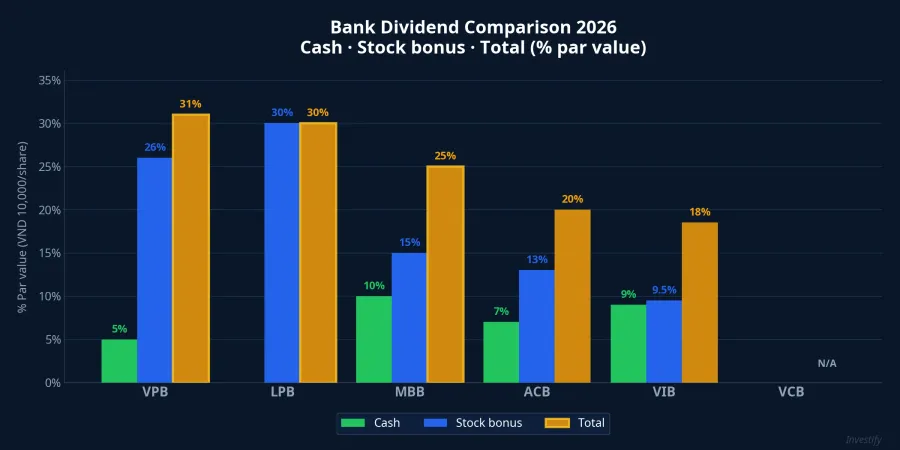
| Bank | Cash | Stock | Total | Current price | Actual cash yield |
|---|---|---|---|---|---|
| VPBank (VPB) | 5% | 26.04% | 31.04% | VND 25,700 | 1.95% |
| LPBank (LPB) | 0% | 30% | 30% | VND 46,100 | 0% |
| MB (MBB) | 10% | 15% | 25% | VND 25,650 | 3.90% |
| ACB | 7% | 13% | 20% | VND 23,300 | 3.00% |
| VIB | 9% | 9.5% | 18.5% | VND 16,600 | 5.42% |
| VCB | 0% | Issuing >1B shares | N/A | VND 57,800 | 0% |
Key point to understand: dividend ratios are calculated on par value of VND 10,000/share, not market price. So the actual cash yield is: (cash dividend × 10,000) ÷ current market price. With VPBank at VND 25,700 and a 5% cash dividend, you actually receive only 1.95% on your invested capital.
Stock Bonuses: More Slices, Same Pizza
Put simply, stock bonuses are like cutting a pizza into 12 slices instead of 8. You have more slices, but the total pizza is the same size, and each slice is smaller.
When a bank issues bonus shares, total market capitalization doesn't change. The number of shares increases, and the price per share drops proportionally. The formula for the theoretical price after ex-dividend date is straightforward:
Post ex-date price = Pre ex-date price ÷ (1 + bonus ratio)
For VPBank, if the pre ex-date price is VND 25,700 and the bonus ratio is 26.04%, the theoretical post ex-date price drops to approximately VND 20,390. That's a 20%+ decline on the ticker, but your total portfolio value remains unchanged. You're neither richer nor poorer.
However, reality is more complex than theory. In the first 1-3 sessions after ex-date, stock prices often drop more than the theoretical level due to selling pressure from short-term traders. For banks with solid profit fundamentals like MBB or ACB, prices typically recover gradually over 10-20 sessions. But stocks with high bonus ratios like LPB (30%) or VPB (26%) need more time for the market to absorb the new supply.
Cash Yield vs. Savings Deposits: Who Wins?
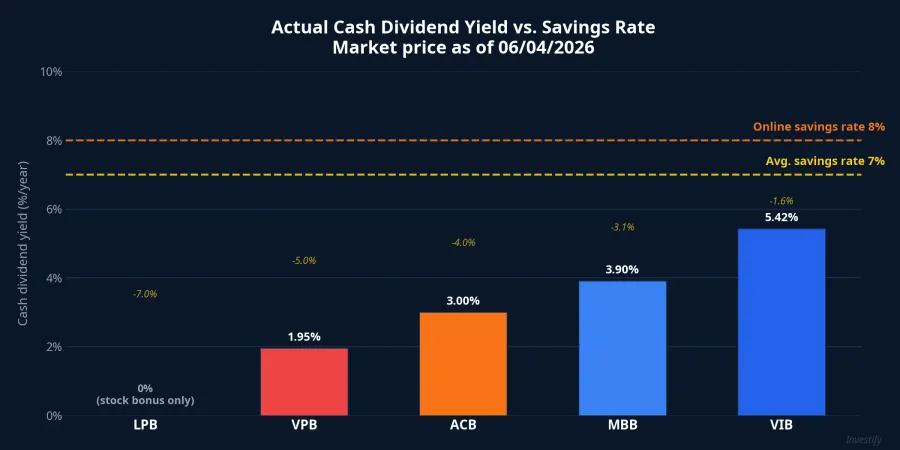
This is the part that directly affects your wallet. As of early April 2026, 12-month savings deposit rates are quite attractive: state-owned banks (VCB, VietinBank, BIDV) offer around 5.9%/yearDNSE, private banks like LPBank offer 7.4%CafeBiz, and HDBank offers up to 8.1% for 13-month terms.CafeF Online deposits at HLBank can reach 8%/year.CafeF
The direct comparison tells a clear story: no bank pays enough cash dividends to compete with savings rates. VIB has the highest yield in the group (5.42%) but still falls short of HLBank's online deposit by nearly 2.6 percentage points. LPBank pays no cash at all. And VPBank, despite the impressive "31%" headline, delivers only 1.95% in cash yield.
This doesn't mean bank stocks are bad investments. But if you're buying them solely for dividends, you're using the wrong tool. Cash dividends from banks are the "cherry on top," not the main reason to invest.
Why Do Banks Still Issue Stock Bonuses?

You might wonder: if stock bonuses don't deliver cash to shareholders, why do banks keep doing it? The answer lies in their capital expansion strategy.
VPBank aims to raise its charter capital to VND 100 trillion, becoming the first private bank to reach this milestone.VietnamBiz MB targets charter capital exceeding VND 102 trillion.CafeF LPBank focuses on capital growth through stock dividends to meet Basel II/III requirements.VnExpress
With the State Bank of Vietnam tightening capital adequacy ratio (CAR) standards and banks racing to scale up, retaining profits through stock bonuses is a rational long-term growth strategy. However, you need to understand that this benefits the bank's balance sheet, not necessarily shareholders in the short term.
Is the "Dividend Surfing" Strategy Still Effective?
A popular approach is buying shares before the record date for dividend rights, then selling before ex-date. In the current environment, this strategy carries more risk than before.
First, the information is already priced in. LPB surged nearly 7% on April 6 as money flowed in on dividend expectations, meaning most of the "good news" has been discounted.CafeF Second, the broader market is weak; the VN-Index fell 0.54% to 1,674.99 points on April 6 with moderate liquidity, making "wave riding" riskier. Third, high interest rates create significant opportunity costs: each month of capital locked waiting for dividends means missing out on approximately 0.6-0.7% risk-free returns from savings.
What Should Investors Do?
If You Prioritize Steady Income
VIB and MBB are the most reasonable choices thanks to higher cash yields (5.42% and 3.9%). VIB targets VND 11,550 billion in profit for 2026, up 27%, while completing Basel III implementation.CafeF MB aims for VND 39,400 billion in profit and VND 2 quadrillion in total assets.Tin nhanh Chứng khoán However, both still lag behind savings rates, so they're only suitable when you also expect share price appreciation.
If You Prioritize Long-term Growth
VPBank and LPBank have interesting growth stories. VPBank targets VND 41,323 billion in profit, up 35%, becoming the first private bank to aim for over VND 40 trillion.VietnamBiz But you need to watch whether profit growth can offset the 26% dilution.
A Practical Perspective
With savings rates at 7-8%/year, you shouldn't buy bank stocks solely for dividends. Investment decisions should be based on profit growth prospects, asset quality, and valuation. Dividends are just a bonus, not the main reason.
Conclusion: Look Beyond the Headline Numbers
The 2026 bank AGM season teaches an important lesson for all individual investors: aggregate dividend numbers don't reflect actual benefits. The bulk of the "massive" 20-31% dividends is stock bonuses — a form of bank capital raising, not shareholder income.
With savings rates at 7-8%/year, actual cash yields from bank stocks (ranging 0-5.4%) can't compete on income alone. You need to look beyond the headline, focus on each bank's growth quality, and most importantly: don't confuse "getting more shares" with "getting more money."