


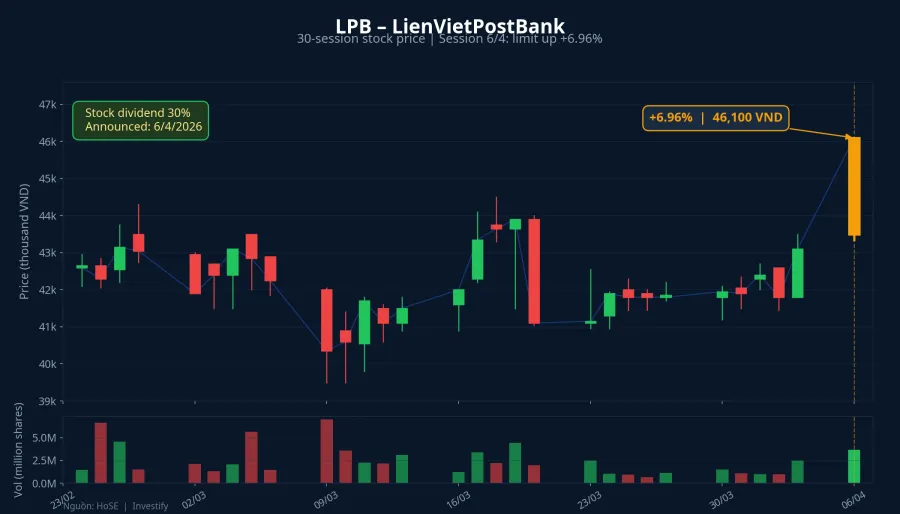
Looking at the numbers, the trading session on April 6, 2026 told a fascinating story. The VN-Index dropped 0.54% to 1,674.99 points, with 263 stocks declining and only 67 advancing. Yet amid the sea of red, LPB surged impressively: hitting the ceiling at +6.96% to 46,100 VND, with trading volume reaching 3.68 million shares — nearly four times its recent average. Over the week from March 31 to April 6, LPB gained roughly 10% from 41,900 VND.
The catalyst behind this breakout was the news that LPBank plans to propose a 2025 stock dividend at a ratio of up to 30% at its 2026 Annual General Meeting (AGM) — the highest among listed banks this season.CafeF
Four banks, four capital plans
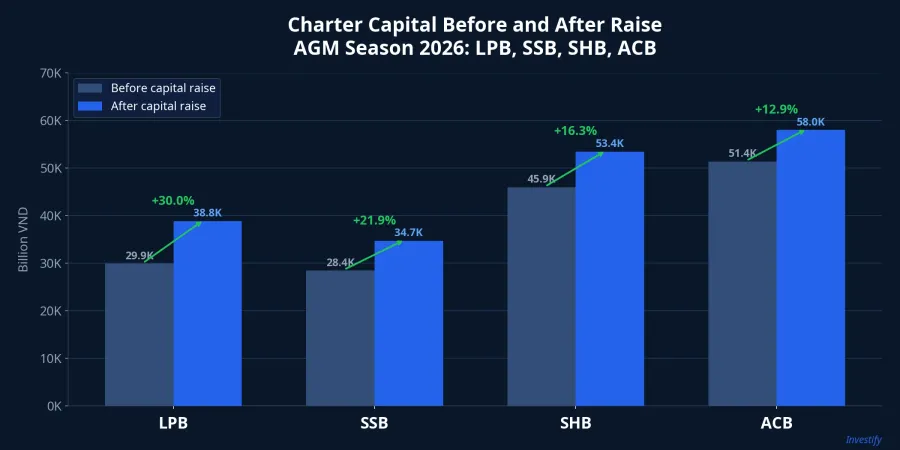
LPBank is not alone. The April–May 2026 AGM season is witnessing an unprecedented wave of charter capital increases across joint-stock commercial banks.VietnamPlus Looking at each bank's specific figures, the picture becomes clearer.
LPBank (LPB) plans to issue stock dividends at a 30% ratio, meaning shareholders holding 100 shares will receive 30 new shares.CafeF With approximately 2.987 billion shares outstanding, the bank will issue roughly 896 million new shares, raising charter capital from 29,870 billion VND to approximately 38,830 billion VND. This is the highest stock dividend ratio among listed banks.
SeABank (SSB) proposes raising charter capital from 28,450 billion VND to 34,688 billion VND (up 21.92%) by issuing 583.8 million shares as dividends at a 20.5% ratio and up to 40 million ESOP shares.VietnamBiz The 2026 pre-tax profit target is set at 7,068 billion VND.KienThuc The AGM is scheduled for April 22, 2026. SSB closed at 16,750 VND on April 6, down 0.30%.
SHB has received State Bank approval to raise charter capital to 53,442 billion VND by issuing 750 million new shares, including offerings to existing shareholders, private placements, and ESOP.NhịpSốngKinhDoanh In 2025, SHB achieved pre-tax profit of 15,028 billion VND, up 30% year-over-year.VietnamBiz SHB closed at 14,700 VND on April 6, down 1.34%.
ACB proposes a 2025 dividend at 20%, comprising 13% in stock (issuing 667.77 million new shares) and 7% in cash, with total payout of approximately 10,273 billion VND.VietnamBiz Charter capital is expected to rise above 58,000 billion VND, with a 2026 profit target up 14%.Vietstock ACB closed at 23,300 VND on April 6, down 0.85%.
Why are banks raising capital right now?
The deepest root cause behind this wave is Vietnam's Basel III implementation roadmap.NguoiQuanSat Under the State Bank's draft circular, commercial banks must raise their minimum Capital Adequacy Ratio (CAR) to 10.5% by 2033, including minimum CET1 of 7%, Tier 1 of 8.5%, and a capital conservation buffer of 2.5%.VietnamPlus
Currently, only about 10 banks are applying Basel III relatively comprehensively, including ACB, LPBank, SeABank, VIB, HDBank, and several other major banks.DNSE This means the majority of banks in the system are still "sprinting" to meet new requirements.
What makes this even more significant is that from 2026, the State Bank plans to shift to a credit growth allocation mechanism based on CAR. Banks with higher CAR will receive larger credit limits — creating a direct competitive advantage. This is precisely why banks are racing to raise capital: not just to meet regulatory requirements, but to gain an edge in the credit growth race.
The market context makes the race even more intense. The VN-Index declined for four consecutive sessions from 1,702.93 points (April 1) to 1,674.99 points (April 6), losing about 1.6% in the first week of April. Yet in this challenging environment, LPB's nearly 7% surge against the trend shows that capital flows are "repricing" banks with strong capital increase plans.
Stock dividends: substance versus psychology
This is where many retail investors still get confused. In essence, stock dividends do not create new value for shareholders — they simply divide the existing pie into more pieces. If a bank pays a 30% stock dividend, the reference price after the ex-date will be adjusted down by approximately 23% (= 30/130).
Take the LPB example: if the price before the ex-date is 46,100 VND, the adjusted reference price would be approximately 35,460 VND. A shareholder with 100 shares worth 4.61 million VND would have 130 shares, but the total value remains about 4.61 million VND — theoretically unchanged.
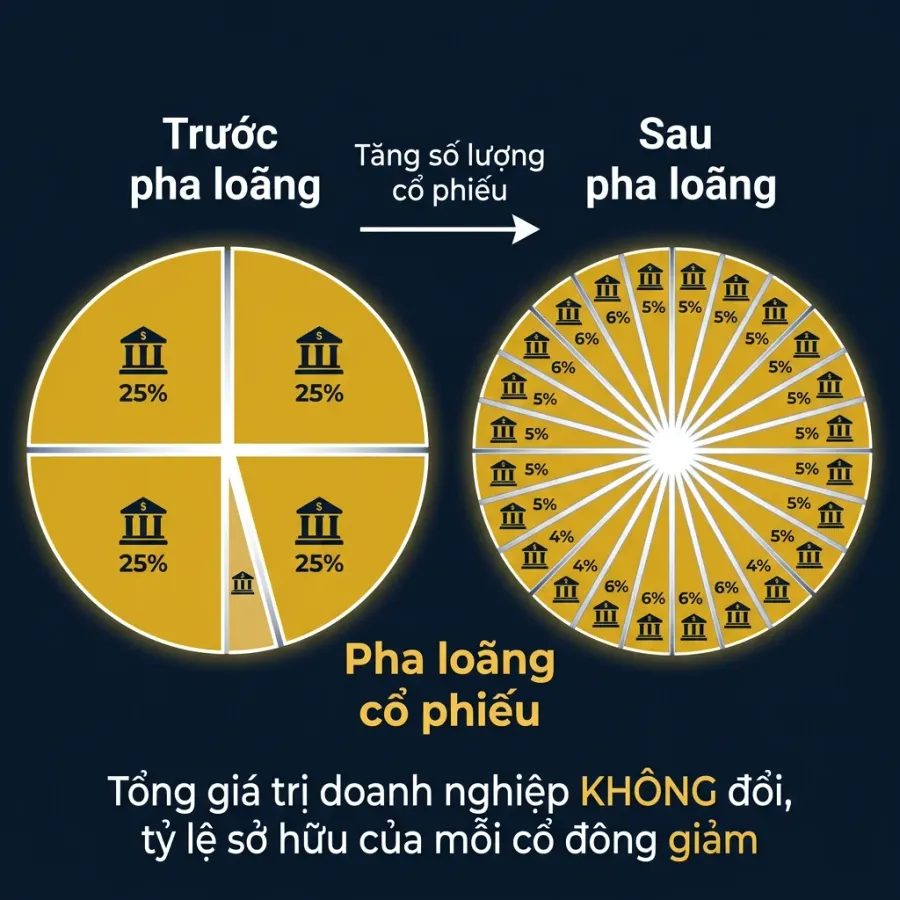
So why does the market still get excited? Two main reasons. First, the psychology of "receiving free shares" remains powerful among retail investors, even though prices adjust accordingly. This psychological effect pushes prices up before the ex-date. Second, the lower post-adjustment price attracts new capital flows — stocks appear "cheaper" on the trading board, drawing new investors in, especially for banks with solid fundamentals.
But the real value lies elsewhere. Capital increases help banks expand their business capacity. Under the new CAR-based credit mechanism, every additional unit of capital directly translates into larger credit limits, generating higher net interest income (NII) in the future.
Classification: genuine versus compliance-driven capital raises
Looking at the numbers, two distinct groups emerge in this capital raising season.
The genuine capital raisers include LPBank and ACB. LPBank's 30% stock dividend comes entirely from retained earnings, and its 10% stock price gain during the week shows market confidence in the quality of its capital raise. ACB pays both cash (7%) and stock (13%) dividends, demonstrating that the bank can afford to pay real money to shareholders while simultaneously increasing capital. Its 14% profit growth target reflects confidence in deploying new capital effectively.VietnamBiz
The compliance-driven raisers include SHB and SeABank. SHB is issuing 750 million new shares including offerings to outside investors, not solely from profits. SHB's CAR is the lowest in the group, indicating greater Basel III compliance pressure. SeABank's 21.92% capital increase combines stock dividends and ESOP, but its 7,068 billion VND profit target is relatively modest compared to its new capital base.KienThuc
What should retail investors consider?

For investors considering banking stocks this AGM season, there are two main strategies. Buying before the ex-date works if you believe the price will recover quickly after dilution, but the risk is that expectations may already be priced in — as LPB already gained 10% during the week. Buying after the ex-date is safer: wait for the price to adjust to its new reference level, suitable for medium and long-term investors.
Four key criteria to evaluate before making a decision. First, post-raise ROE: only banks that maintain high ROE after capital increases are truly worth investing in. Second, the source of capital increase: prioritize banks raising capital from retained earnings (LPB, ACB) over those issuing new shares. Third, compare the 2026 profit growth target with the dilution rate — profit must grow faster than dilution for shareholders to truly benefit. Fourth, current CAR: banks with already-high CAR (ACB, LPBank) are raising capital for growth, while low-CAR banks (SHB) are raising capital out of necessity.
Bank AGM schedule for April 2026
| Bank | AGM Date | Stock Dividend | Charter Capital Increase |
|---|---|---|---|
| SeABank (SSB) | April 22, 2026 | 20.5% | To 34,688B (+21.92%) |
| SHB | April 22, 2026 | Not yet detailed | To 53,442B |
| ACB | April 2026 | 13% stock + 7% cash | To 58,000B |
| LPBank (LPB) | April 2026 | 30% | To ~38,830B (+30%) |
Looking at the full picture, the 2026 banking AGM season is far more than just a "gift-giving" dividend season. Behind the attractive 20–30% figures lies a mandatory capital race to meet Basel III standards and gain an edge under the new credit allocation mechanism. Investors need to look beyond the psychological appeal of "free shares" to evaluate the true quality of each capital raise. LPB's 6.96% breakout amid a broad market decline sends a clear signal: smart money is already distinguishing between banks raising capital from internal strength and those doing it merely to comply.