
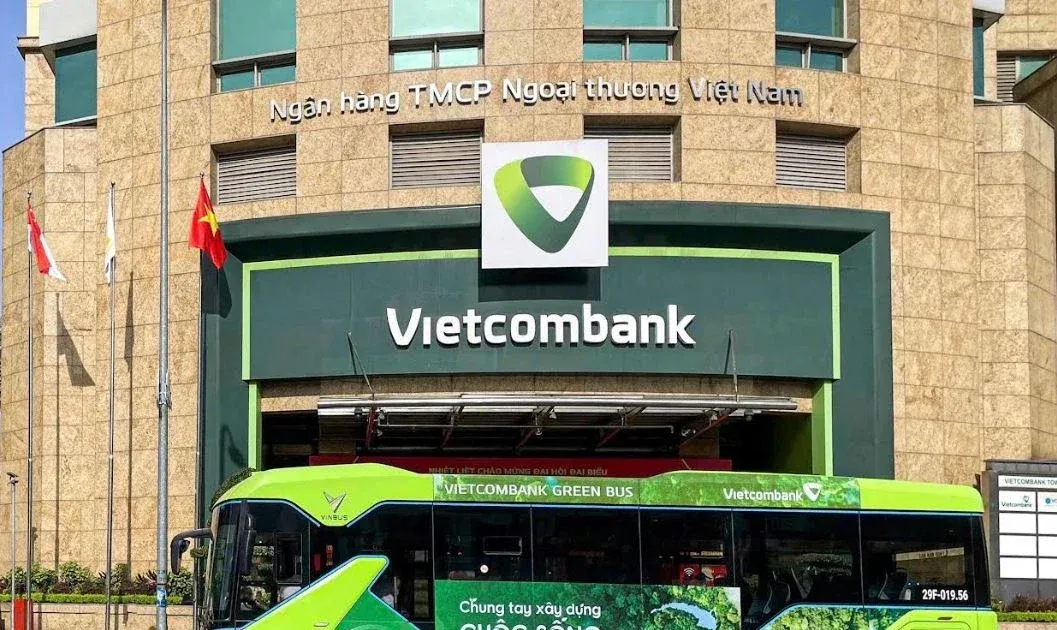

Under the 2021-2025 banking system restructuring roadmap, the State Bank of Vietnam set targets to strengthen the financial capacity of systemically important commercial banks. 2026 marks a turning point as the four largest banks simultaneously announce record capital raising plans, with Vietcombank leading through two strategic moves: issuing over 1 billion bonus shares and establishing a subsidiary at the Vietnam International Financial Center.
Over 1 billion bonus shares: laying the foundation for bigger ambitions
Vietcombank (VCB) has just released documents for its 2026 Annual General Meeting, scheduled for April 24 at Ecopark, Hung Yen. The key highlight: the bank plans to issue up to 1.068 billion bonus shares to existing shareholders, sourced from the Charter Capital Supplementary Reserve Fund accumulated through the end of 2023. The total issuance value at par reaches approximately VND 10,687 billion, raising VCB's charter capital from VND 83,557 billion to approximately VND 94,243 billion.CafeF
With approximately 8.356 billion shares currently outstanding, the issuance ratio is about 12.78%. In other words, for every 100 VCB shares held, shareholders will receive nearly 13 new shares. However, investors should note that bonus shares do not create immediate additional value: total equity remains unchanged, as it is merely an internal transfer from reserves to charter capital. The reference price will adjust downward proportionally after the record date.
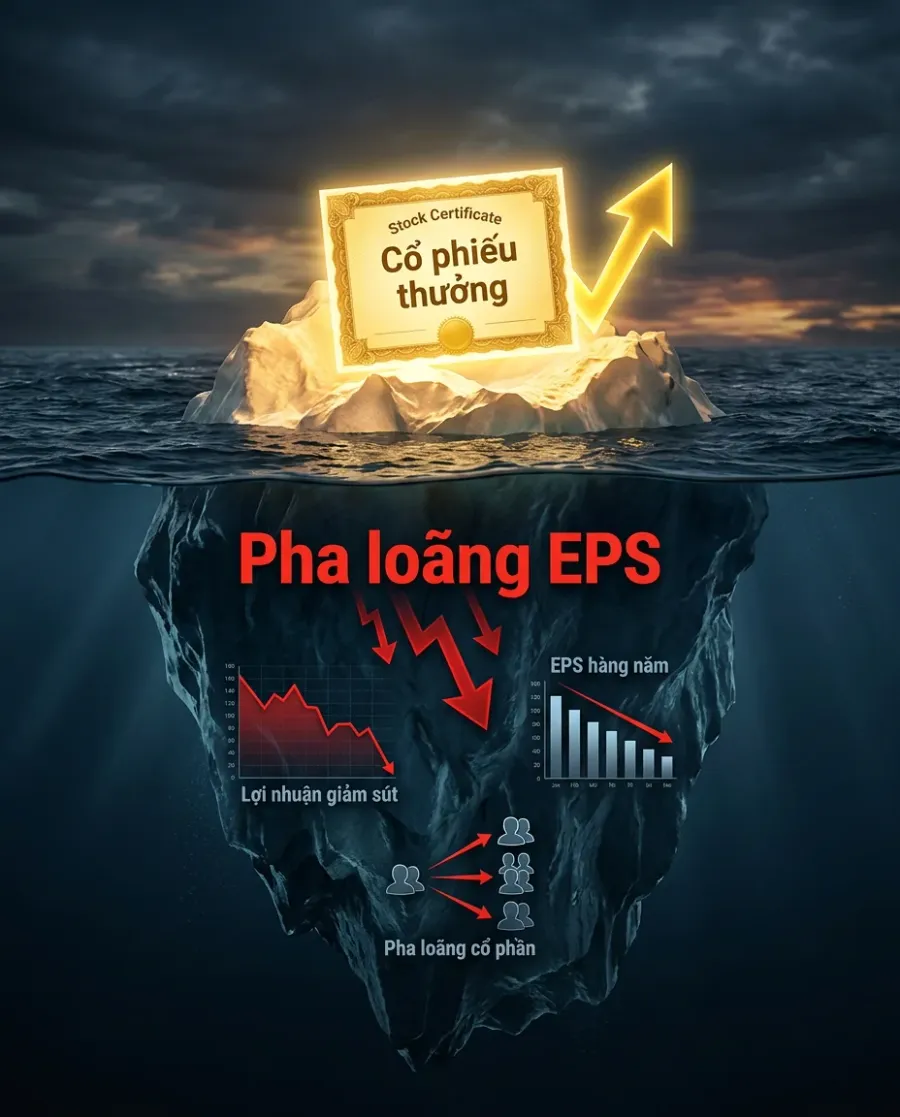
The real benefit of this issuance lies in its long-term strategic significance. A larger capital base allows VCB to expand credit more aggressively, meet Capital Adequacy Ratio (CAR) requirements under Basel III standards, and create room for new business activities. With Vietnam targeting 8% GDP growth in 2026, banks with strong capital will be the ones leading credit expansion for the entire system.
VIFC subsidiary: gateway to green finance
The second notable agenda item at the AGM is the proposal to establish a wholly-owned domestic commercial bank subsidiary operating at the Vietnam International Financial Center (VIFC), with planned charter capital of VND 3,000 billion.VietnamFinance
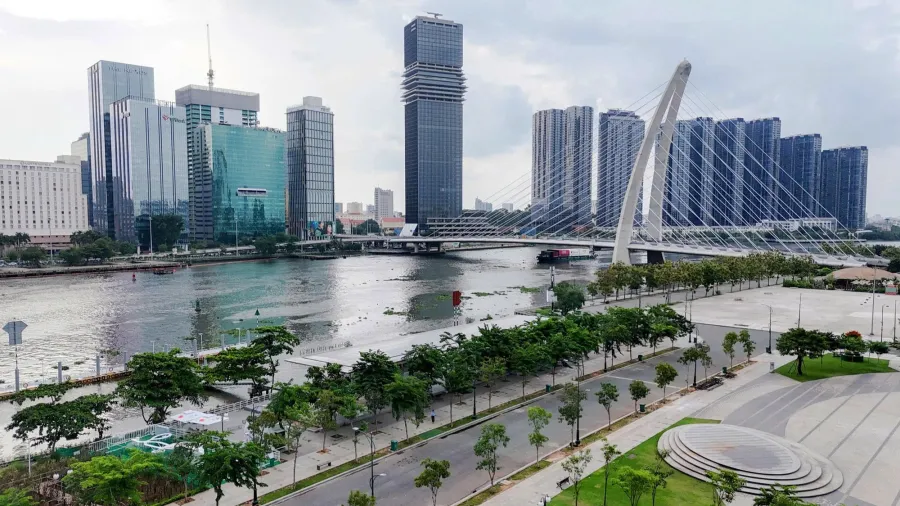
This is not simply opening another branch. VIFC is being built with a sandbox mechanism that allows controlled experimentation with new financial products that the traditional banking system cannot yet deploy. VCB's subsidiary there will focus on three strategic areas: green finance and ESG (mobilizing international capital for sustainable projects, issuing green bonds); carbon credit trading on the exchange expected to operate during 2026-2030 at VIFCVIFC; and digital asset experimentation including asset tokenization and cross-border blockchain payments within the sandbox framework.
VCB currently owns two banking subsidiaries: VCBNeo and a subsidiary in Laos. The VIFC bank will be its third entity with a "digital-first" and "green-first" orientation. VCB is not alone; numerous other banks are also preparing to establish subsidiaries at VIFC, signaling that competition for positioning within the new financial ecosystem has officially begun.Dân trí
The VND 100 trillion capital race: four banks, one target
Vietcombank is not the only bank sprinting. At least four major banks are targeting VND 100 trillion in charter capital in 2026.VietnamPlus
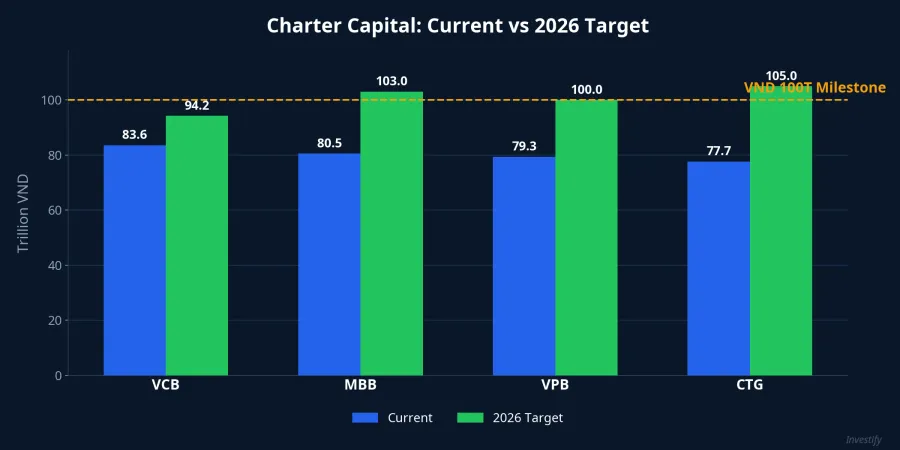
VPBank has confidently declared it will be the first bank to surpass this historic milestone through a 26.04% stock dividend plan, raising capital from VND 79,339 billion to over VND 100 trillion.VietnamPlus MB is not far behind with a combined dividend and additional issuance plan targeting VND 103 trillion. VietinBank has set the most ambitious target: surpassing VND 105 trillion by retaining all profits from 2023-2024.Thời báo Tài chính
As for VCB, the VND 94,243 billion mark is just the first step since it excludes additional private placement plans. Including those, VCB could very well approach or exceed the VND 100 trillion threshold this year.
Why the VND 100 trillion milestone matters for investors
The capital race is not just about numbers on a balance sheet. Large charter capital delivers three strategic advantages for banks.
First, meeting Basel III requirements. The CAR includes Tier 1 core capital, the Capital Conservation Buffer (CCB), and the Countercyclical Capital Buffer (CCyB). For Domestic Systemically Important Banks (D-SIBs) like VCB, these requirements are even more stringent; strong capital is a prerequisite for maintaining compliance.
Second, expanding credit headroom. Credit limits are calculated based on a bank's equity, meaning larger capital translates directly into greater credit growth capacity. With the economy targeting 8% GDP growth, banks need sufficient ammunition to finance infrastructure, manufacturing, and real estate projects.
Third, supporting market upgrade. The banking system's capital strength is among the criteria FTSE Russell evaluates when considering Vietnam's upgrade from Frontier to Emerging Market status. Well-capitalized banks improve the market's ability to absorb foreign capital flows and stabilize liquidity, creating a foundation for stronger international capital inflows should Vietnam achieve the upgrade.
VCB price action and key factors to watch
VCB shares are currently trading around VND 58,000 (as of April 3), with a market capitalization of approximately VND 484.6 trillion, the largest in the banking sector. Over the past 30 days, the stock has declined more than 12% in line with broader market trends.
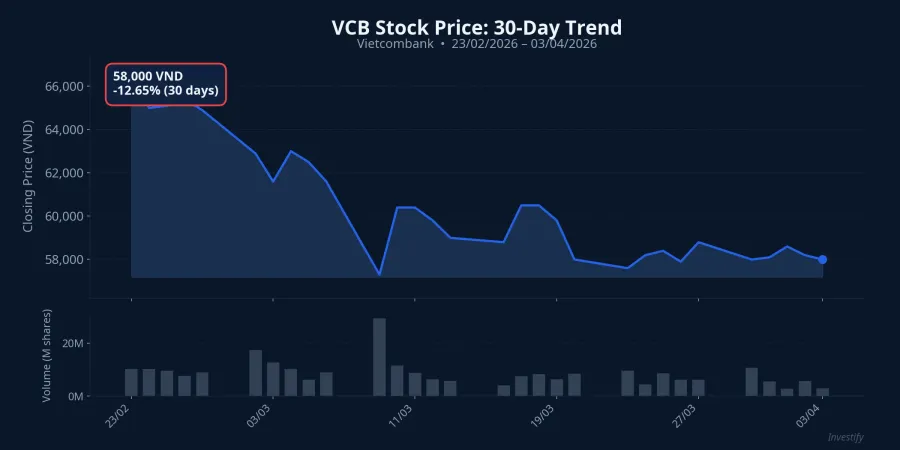
After the bonus share issuance, the reference price will adjust downward proportionally due to dilution, but total portfolio value remains unchanged. Investors should monitor three key factors in the coming period. First, the record date for bonus share entitlement, which the Board of Directors will determine after the AGM on April 24. Second, progress on establishing the VIFC subsidiary, which depends on the sandbox legal framework still being finalized. Third, the race to VND 100 trillion will reshape Vietnam's banking landscape for the next decade, and investors should closely follow AGM results from all four banks throughout April.