

What the report doesn't spell out: Novaland is profitable on paper, but the vault is still empty. And with margin trading restored, hot money flowing in could obscure the structural risks that remain unresolved.
From the "blacklist" to a surprise margin reinstatement
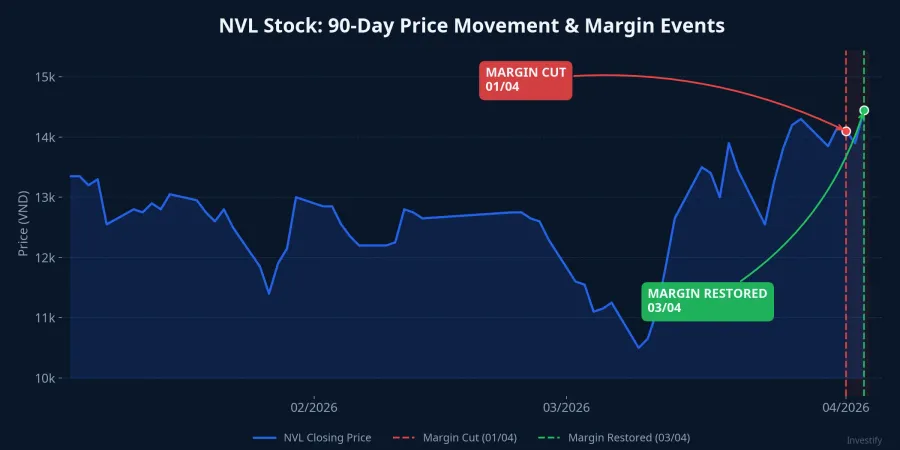
Just two days ago, on April 1st, NVL was still on the list of 73 stocks barred from margin trading in Q2/2026 by HoSE.Nguoi Quan Sat But this morning on April 3rd, news of NVL's margin reinstatement spread rapidly, pushing the stock up 3.6% to VND 14,400 with over 14.3 million shares traded — double the previous session's volume.CafeF
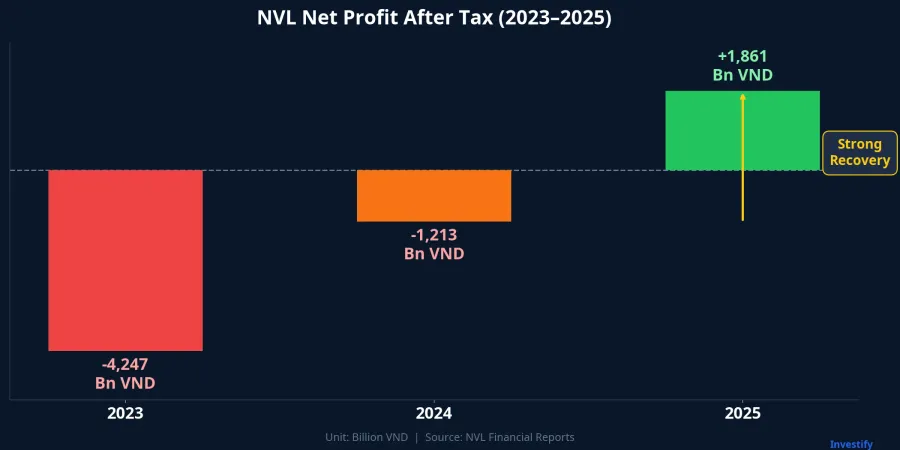
The direct catalyst was the 2025 audited financial report: consolidated net profit reached VND 1,861 billion, a dramatic turnaround from the VND 4,400 billion loss in 2024. This was the key condition for HoSE to restore margin trading eligibility. However, the real risk lies in the quality of this profit, and investors who only read the headline number may walk straight into a trap.
2025 audited financials: profit from reversals, not core business
On the surface, 2025 revenue reached VND 6,966 billion with gross profit margin surging to 63.5%, the highest in the cycle.Nguoi Quan Sat However, the majority of profit came from provision reversals related to land lease obligations, land use fees, and late tax penalties at projects like Lakeview City. In other words, this is accounting profit, not actual cash flowing into the business.
Q4/2025 contributed the bulk of the annual result with VND 3,638 billion in profit from mass project handovers.Gov't News The first three quarters, the company was either in the red or barely breaking even. This heavy concentration of profit in a single quarter raises serious questions about the sustainability of the business results.
Auditor's warning: record negative cash flow and going concern doubt
This is the part most investors overlook when they only read headlines. Auditor Moore AISC issued an emphasis of matter: operating cash flow in 2025 was negative VND 6,145 billion, worse than the negative VND 5,971 billion in 2024.Dan Tri Novaland has failed to meet certain short-term debt obligations that have come due.
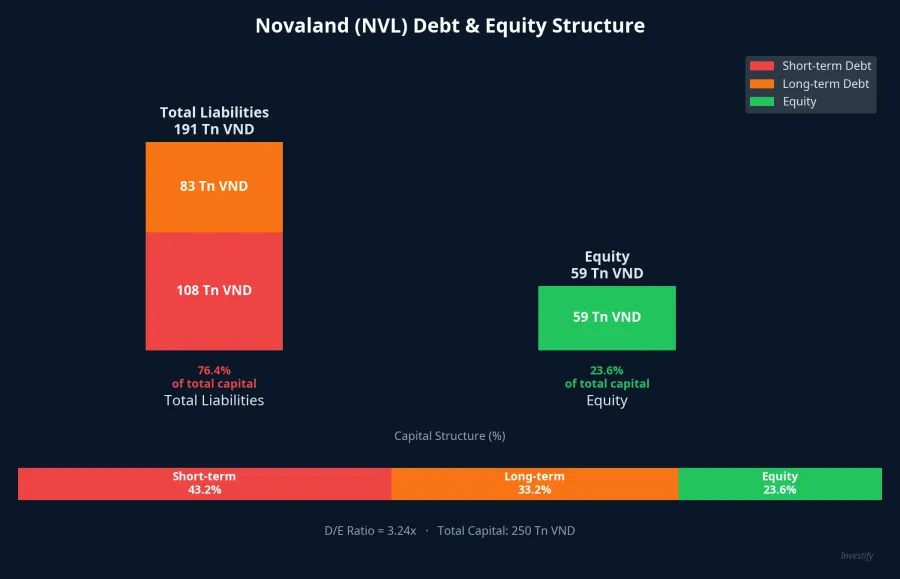
The real risk is clear: the company is profitable on the income statement but generates no cash from operations. Total liabilities amount to VND 191,015 billion, of which financial debt accounts for approximately VND 67,391 billion, while equity stands at just VND 58,893 billion. A D/E ratio of 3.24x indicates extremely high financial leverage, and any legal or market shock could trigger a domino effect.
USD 300 million bond restructuring: reducing debt through dilution
One of the most critical moves was restructuring the USD 298.6 million international bond package (5.25% coupon, maturing 2026) listed on SGX Singapore. 25 bondholders representing USD 284 million (95.11% of outstanding debt) agreed to a debt-to-equity conversion.Thoi Bao Tai Chinh
The initial conversion price was VND 40,000 per share, later adjusted down to VND 36,000.VnEconomy Notably, NVL's current market price is just VND 14,400, over 60% below the conversion price. Bondholders are accepting significant losses on conversion, but in exchange, they gain equity instead of facing default risk. This signals that international creditors assess Novaland's ability to repay in cash as very low.
Beyond international bonds, the 2025 extraordinary general meeting approved issuing shares to convert over VND 8,700 billion in debt, including 151.85 million shares for VND 6,074 billion in principal and 168 million shares for VND 2,646 billion in other obligations.Vietstock The dilution risk for existing shareholders is real and substantial, as every newly issued share further divides the profit pie.
2026 plan: triple the ambition, but where's the money?
Novaland has set a 2026 revenue target of VND 22,715 billion, a 3.26x increase over 2025, with net profit of VND 1,852 billion.Nguoi Quan Sat The company plans to hand over 5,241 units and issue ownership certificates for at least 10 major projects including Sunrise Riverside, The Sun Avenue, and Palm City.
To address the cash flow problem, Novaland plans to liquidate 16 assets to raise approximately VND 18,541 billion, while extending maturities on approximately VND 12,761 billion in loans.Vietnam Business Insider However, Novaland itself admits it will not have sufficient funds to repay its debts by the end of 2026.VNSC When a company openly admits it cannot repay its debts, that is no longer a warning but a reality.
NVL at a crossroads: opportunity or trap?

Margin reinstatement is a technically positive signal that boosts NVL's liquidity and attracts leveraged capital. But investors must clearly distinguish between a technical signal and fundamental strength. Profit largely comes from provision reversals, operating cash flow is more negative than the prior year, total debt stands at a massive VND 191 trillion, and dilution risk continues to grow through each debt-for-equity swap.
If the 2026 plan succeeds with timely project handovers and asset liquidations, NVL could stage a sustainable recovery. Conversely, if project legal issues persist or the real estate market weakens, debt pressure will return with greater force. This is a high-risk speculative play for those who understand exactly what they are betting on, not a value investment for those seeking safety.