


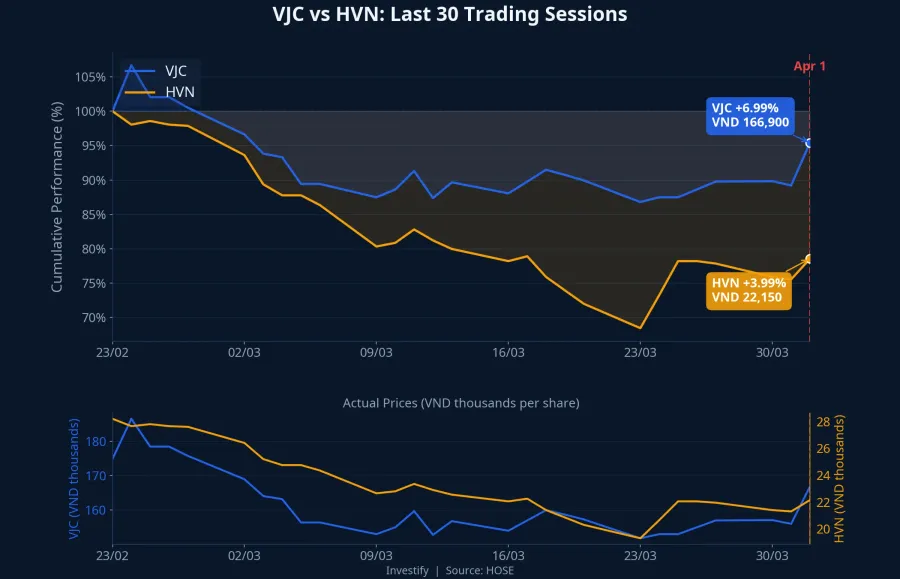
Looking at the numbers from the April 1, 2026 session, the divergence within Vietnam's aviation sector has never been clearer. The VN-Index broke out 1.86% to reach 1,705 points, but the most compelling story lies beyond the index itself. VietJet Air (VJC) surged nearly limit-up at 6.99% to VND 166,900, pushing its market cap to approximately VND 98,700 billion. Meanwhile, Vietnam Airlines (HVN) rose a modest 3.99% to VND 22,150, a tepid recovery after three consecutive declining sessions from VND 22,050 down to VND 21,300.
Same sector, same tailwind from falling oil prices, yet the market is casting two entirely different votes.
Oil Price Reversal: The Catalyst Behind the Breakout
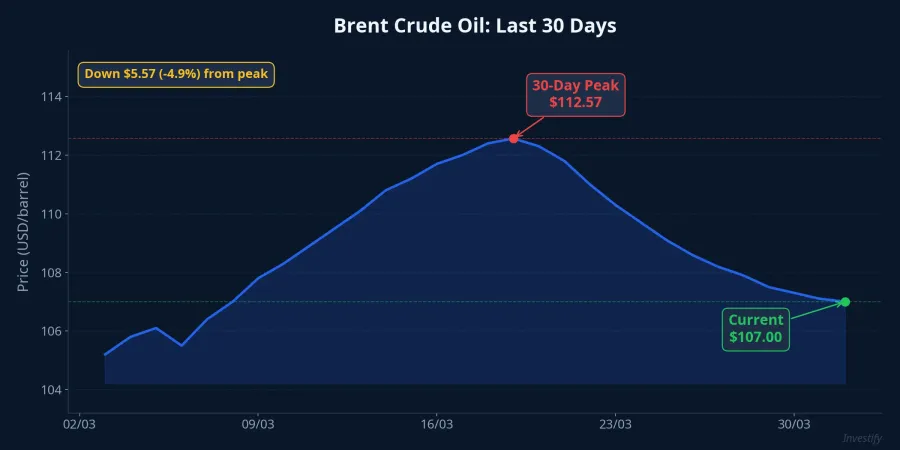
The primary driver of today's session came from Brent crude. After peaking at $112.57 per barrel on March 27, Brent tumbled to $107.35 on March 31, shedding nearly 5% in just four trading sessions. The direct cause was signaling from US-Iran negotiations: President Trump declared the talks "very positive" and delayed strikes on Iranian energy facilities until April 6.CNBC
Earlier, Brent had crashed nearly 11% in a single session to $99.94 on March 23 before recovering sharply.CNBC This extreme volatility reveals that the oil market is currently driven more by geopolitical factors than fundamental supply-demand dynamics.
A crucial detail: fuel costs represent 35-40% of total operating expenses for Vietnamese airlines. Jet A-1 prices in Singapore during March 2026 ranged from $190-200 per barrel, even touching $234 due to the massive premium from the Strait of Hormuz bottleneck.Tuoi Tre A 5% decline in Brent is a positive signal, but is it enough to rescue every airline?
Two Models, Two Levels of Resilience
Examining the cost structure of each carrier reveals a clear answer.

VietJet (VJC) operates as a low-cost carrier with significant structural advantages. Its single-type fleet of A320/A321neo aircraft delivers approximately 20% fuel savings compared to previous-generation planes.Airbus A high proportion of ancillary revenue reduces dependence on ticket margin. The airline also employs OpenAirlines' SkyBreathe AI platform to optimize fuel consumption on every flight. When fuel prices surged, VJC responded swiftly by cutting 18% of April capacity (domestic down 22%, international down 11%) and increasing international fuel surcharges.Thanh Nien
Vietnam Airlines (HVN) as a full-service carrier faces far greater pressure. Its multi-type fleet (A321, A350, B787) consumes more fuel, especially on long-haul routes. High fixed costs from staffing, ground services, and business lounges slow its ability to cut expenses. HVN has already suspended 7 domestic routes since April 1 and plans to cut 700-1,700 flight pairs per month in Q2/2026.CafeF Jet A-1 supply is only sufficient to maintain operations until mid-April 2026.Tuoi Tre
In essence, VJC is a nimble boat that can quickly change course when winds shift, while HVN is a large vessel that needs considerably more time to maneuver.
Brent Is Down, but Jet A-1 Hasn't Followed
A critical detail in the cost picture: falling Brent prices do not automatically translate to equivalent Jet A-1 declines. The Jet A-1 premium over Brent exceeded $30 per barrel in March 2026, primarily due to physical supply chain disruptions at the Strait of Hormuz. Even with Brent at $107, Jet A-1 remains in the $160-200 range. This is a level at which both VietJet and Vietnam Airlines are forced to reduce operations.
The difference lies in response speed. VJC, with its lean cost structure, can rapidly redirect capacity toward more profitable routes. HVN, with its extensive long-haul network and complex service contracts, requires significantly more time to restructure operations.
Three Risks Investors Should Monitor
Today's session shows the market expects VJC to benefit more from the oil-cooling scenario. However, the picture is not entirely rosy.

First, US-Iran negotiations remain uncertain. Iran has denied direct talks with the US, and the deadline for the strike pause extends only to April 6.CNBC Oil prices could reverse sharply upward at any moment if negotiations collapse.
Second, the Jet A-1 premium has not narrowed. Despite Brent falling 5% from its peak, Jet A-1 prices remain at record highs due to physical supply constraints at Hormuz, not merely reference pricing. Airlines will only see genuine relief when this premium compresses.
Third, VJC is not entirely immune either. The airline still has to cut 18% of capacity. This is not a story of one side winning outright. VJC simply suffers less damage thanks to its flexible cost structure, but it is not damage-free.
Lessons from the Divergence
Looking at the April 1 numbers, the clearest lesson for investors is this: when analyzing the impact of a macro variable like oil prices, do not paint an entire sector with the same brush. Business models, cost structures, and adaptability at the individual company level determine who recovers faster.
VJC, with its low costs and flexible response, is being repriced positively by the market as oil cools down. HVN still needs more time to resolve its structural cost and fuel supply challenges. For aviation sector investors, today's session is a reminder that given the same catalyst, the company with a stronger foundation will respond better; and that is always reflected in the stock price.