
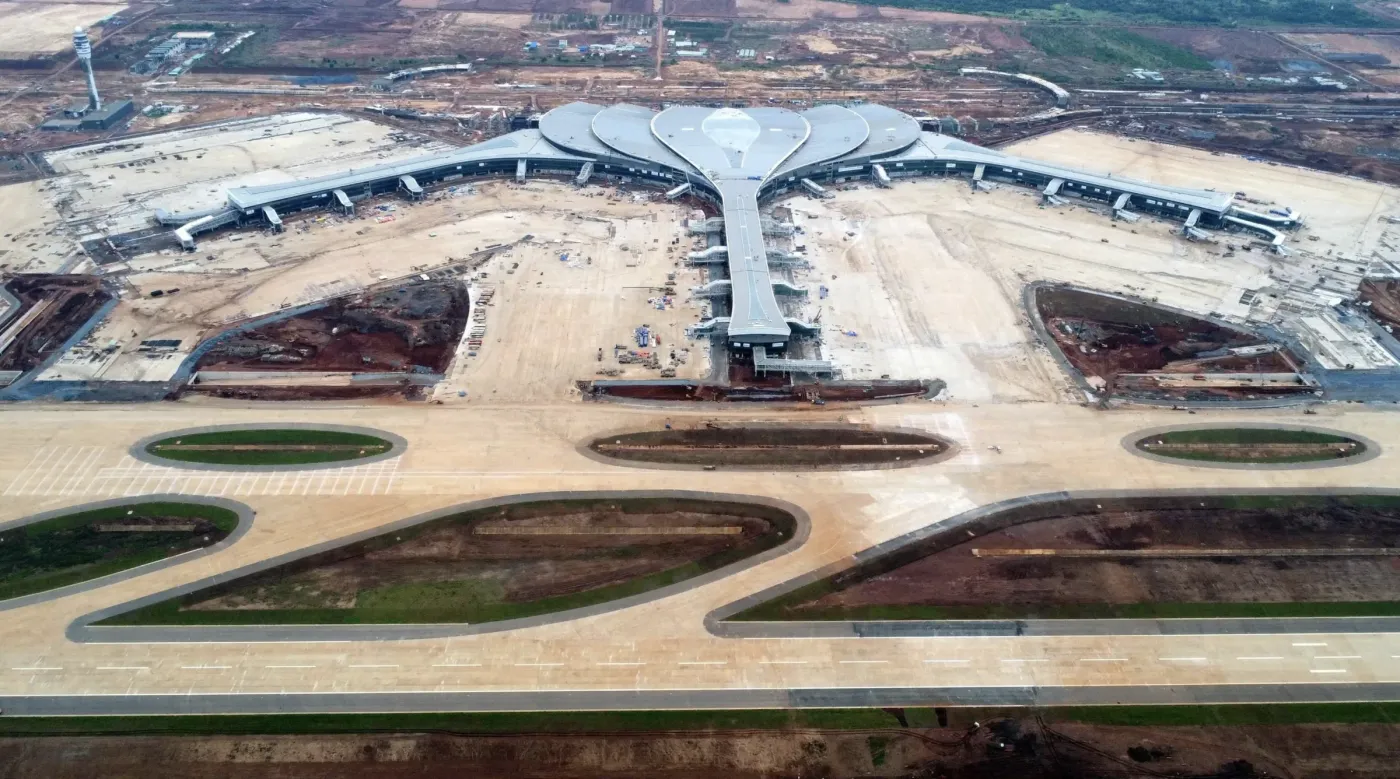

This policy opens an opportunity that many investors have been waiting a decade for. On March 29, 2026, Prime Minister Pham Minh Chinh officially directed the completion of Long Thanh International Airport by Q3/2026 at the latest, with commercial operations starting by year-end.Bao Chinh phu What makes this moment truly special is not just the airport itself — it is an entire infrastructure ecosystem coming together simultaneously, creating an investment landscape with multiple layers of opportunity.
A Megaproject Sprinting to the Finish Line
Phase 1 of Long Thanh Airport carries a total investment of over VND 109,000 billion (approximately $4.6 billion), with a designed capacity of 25 million passengers and 1.2 million tons of cargo annually.VietnamBiz As of late March 2026, the runway and apron are essentially complete, while the passenger terminal is in the final stages of interior finishing and equipment installation. However, schedule pressure remains intense with the construction site requiring up to 14,000 workers, all while the eastern monsoon season approaches.
If everything stays on track, Long Thanh will become the second aviation gateway for southern Vietnam — relieving the chronic overload at Tan Son Nhat. Over the next 3-5 years, this will be the foundation for the entire Southeast region to restructure its logistics flows and attract FDI.
Three Expressways Reaching Completion Simultaneously
What creates the compounding effect is three major expressways completing in 2026, forming an unprecedented connectivity network for Long Thanh Airport.
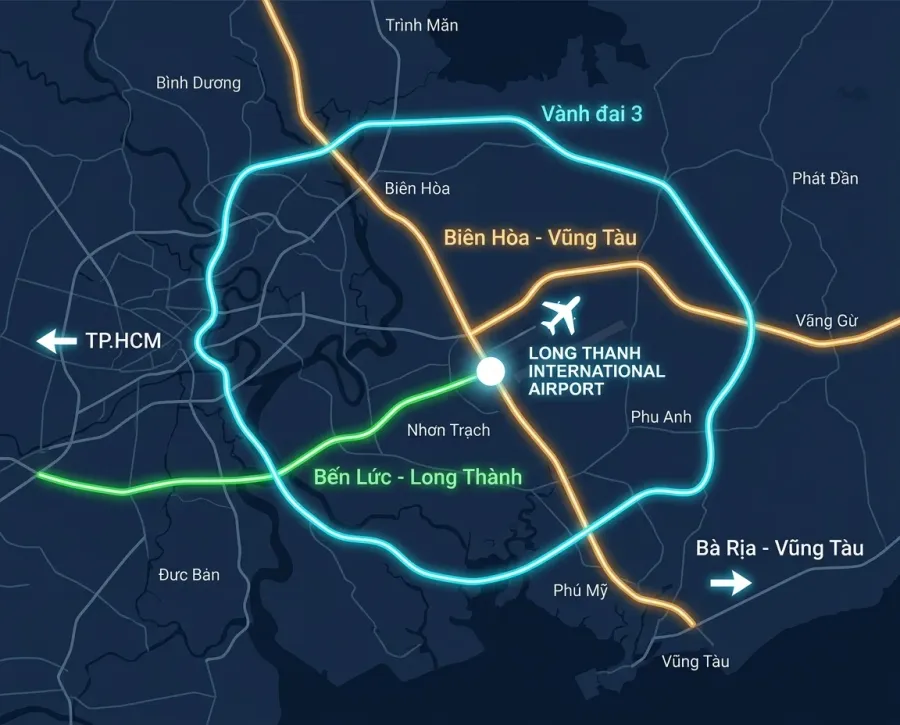
Bien Hoa — Vung Tau Expressway has reached over 70% completion, targeting operations in H1/2026.Tuoi Tre This route shortens the HCMC — Vung Tau distance from 120 km to just 76 km, opening a new economic corridor for Ba Ria — Vung Tau province. Ring Road 3 HCMC has its 11 km Dong Nai section technically opened, with full completion targeted before April 30, 2026.Bao Dong Nai Finally, the Ben Luc — Long Thanh Expressway spanning nearly 58 km has reached over 88% overall progress, targeting full opening in September 2026.Bao Lam Dong
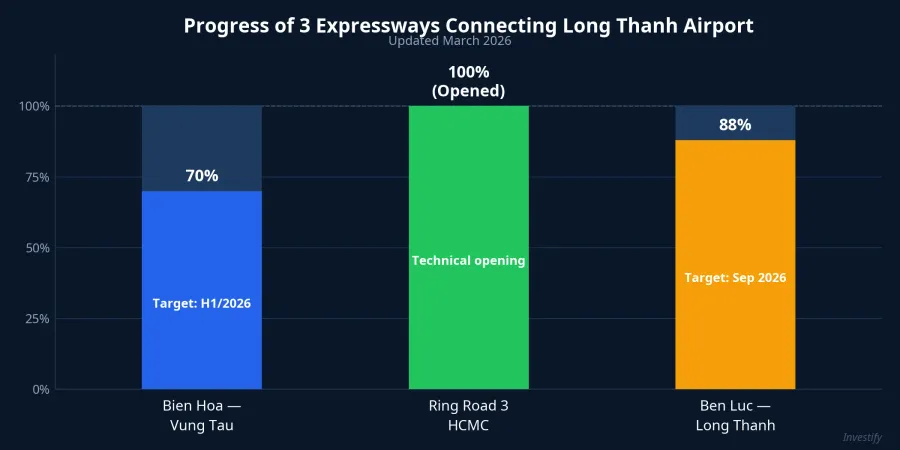
When all three routes are complete, Long Thanh Airport will be directly connected to HCMC, Ba Ria — Vung Tau, and the entire Southeast region. This is not just a transportation story — it is the formation of an entirely new economic-logistics axis where transit times from industrial parks to the airport and seaports are dramatically reduced.
Stock Map — Who Wins First, Who Wins Later?
Infrastructure Construction — Immediate Beneficiaries
This group is already benefiting from the surge in public investment disbursement. CTD (Coteccons) is trading around VND 85,400 with a market cap of VND 9,100 billion, recording a record backlog and its highest net profit in 7 years. HHV (Deo Ca) at VND 12,300 is directly involved in operating multiple key expressways, with its parent group continuously registering to buy large volumes of shares — a signal that insiders have high confidence in the outlook.
Industrial Real Estate — An Undercurrent Waiting to Surge
As transport infrastructure completes, industrial park rental rates are forecast to increase 7-9% annually according to sector analysis reports.FHSC BCM (Becamex) at VND 53,100 is the largest industrial park developer in Binh Duong with 659 hectares of land ready for lease and a market cap of VND 55,000 billion. SZC (Sonadezi Chau Duc) at VND 29,150 owns 11 industrial parks in Dong Nai, directly benefiting from the Long Thanh — Vung Tau connectivity axis. Over the next 3-5 years, this group stands to gain the most as FDI flows into areas with synchronized logistics infrastructure.
Aviation and Logistics — The Long-Term Story
ACV (Airports Corporation of Vietnam) at VND 45,300 with a market cap of VND 162,300 billion is the operator of Long Thanh Airport. Terminal T3 at Tan Son Nhat is already operational (adding 20 million passengers/year), and Long Thanh Phase 1 will add another 25 million passengers/year. However, the initial operating phase may create cost pressure before profits break out from 2027 onward.VnEconomy
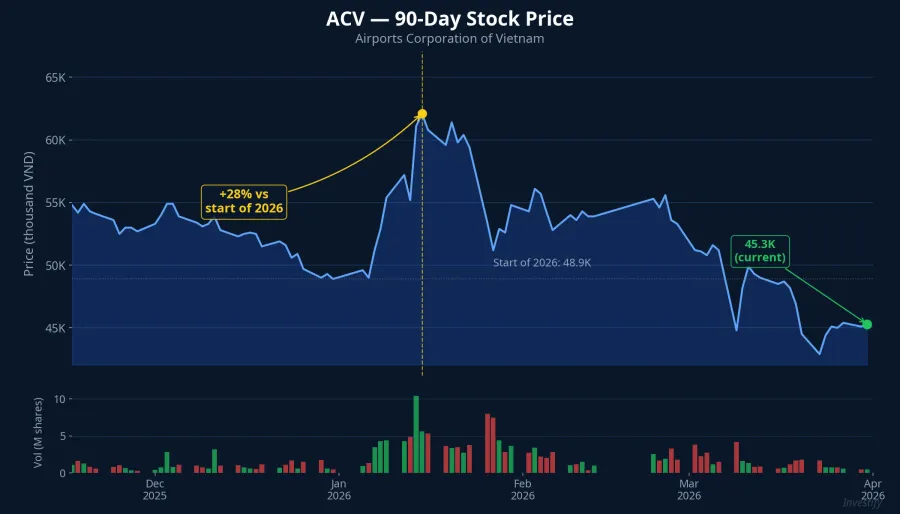
The chart shows ACV surged 28% from the start of the year to a peak of VND 62,100 in mid-January 2026, but has since corrected significantly to VND 45,300. This is a crucial signal: the market priced in expectations early, and new investors need to consider whether the current price already reflects the operational risks of the initial phase.
Lessons from Changi and Suvarnabhumi
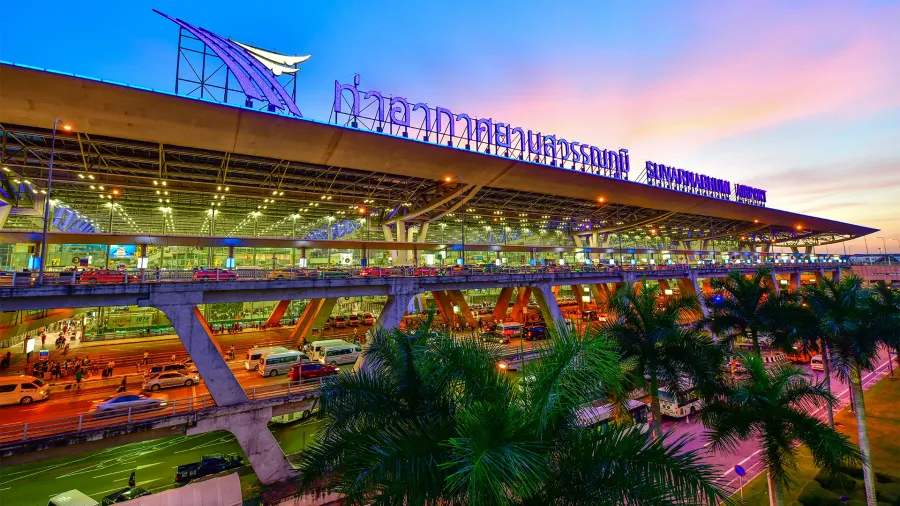
International experience provides clear evidence. Changi Airport transformed eastern Singapore into Southeast Asia's logistics hub. Suvarnabhumi (Thailand), opened in 2006, drove surrounding land prices up 3-5x within a decade. If Long Thanh stays on schedule, the Nhon Trach — Long Thanh — Ba Ria corridor could replicate a similar scenario, especially given that the transport connectivity is far more comprehensive than what Suvarnabhumi had at launch.
Risks to Consider
Despite the attractive outlook, investors should remain clear-eyed about several real risks. First, schedule delays remain a present danger given the project's history of deadline adjustments. Second, valuations may already reflect expectations — stocks like ACV previously surged over 28% YTD, and CTD rallied on strong earnings; investors buying at peak expectations must account for a "buy the rumor, sell the news" scenario. Third, ACV's financial pressure will intensify as Phase 2 (expanding to 50 million passengers/year) demands massive capital. Finally, with VND 13,700 billion in real estate bonds maturing in April 2026, industrial real estate — while less risky than residential — still requires liquidity monitoring.
Conclusion — Opportunity Remains, But Selectivity Is Key
Long Thanh Airport together with three expressways reaching completion simultaneously is creating an unprecedented infrastructure ecosystem in Southeast Vietnam. Construction stocks benefit immediately, while industrial real estate and logistics will break out once the infrastructure is operational. However, with the VN-Index at 1,674 points (March 31 session) and many stocks already having rallied, investors need to clearly distinguish between expectations and reality. Prioritize companies with solid financial foundations, clear backlogs, and location advantages — rather than chasing short-term speculative waves.