

The big picture reveals something few dared to believe 12 months ago: Vietnam's exports to the US not only survived but reached a new record. Behind the impressive headline numbers, however, lies a story of deep sectoral divergence — and policy risks that never truly went away.
The Panic of April 2025
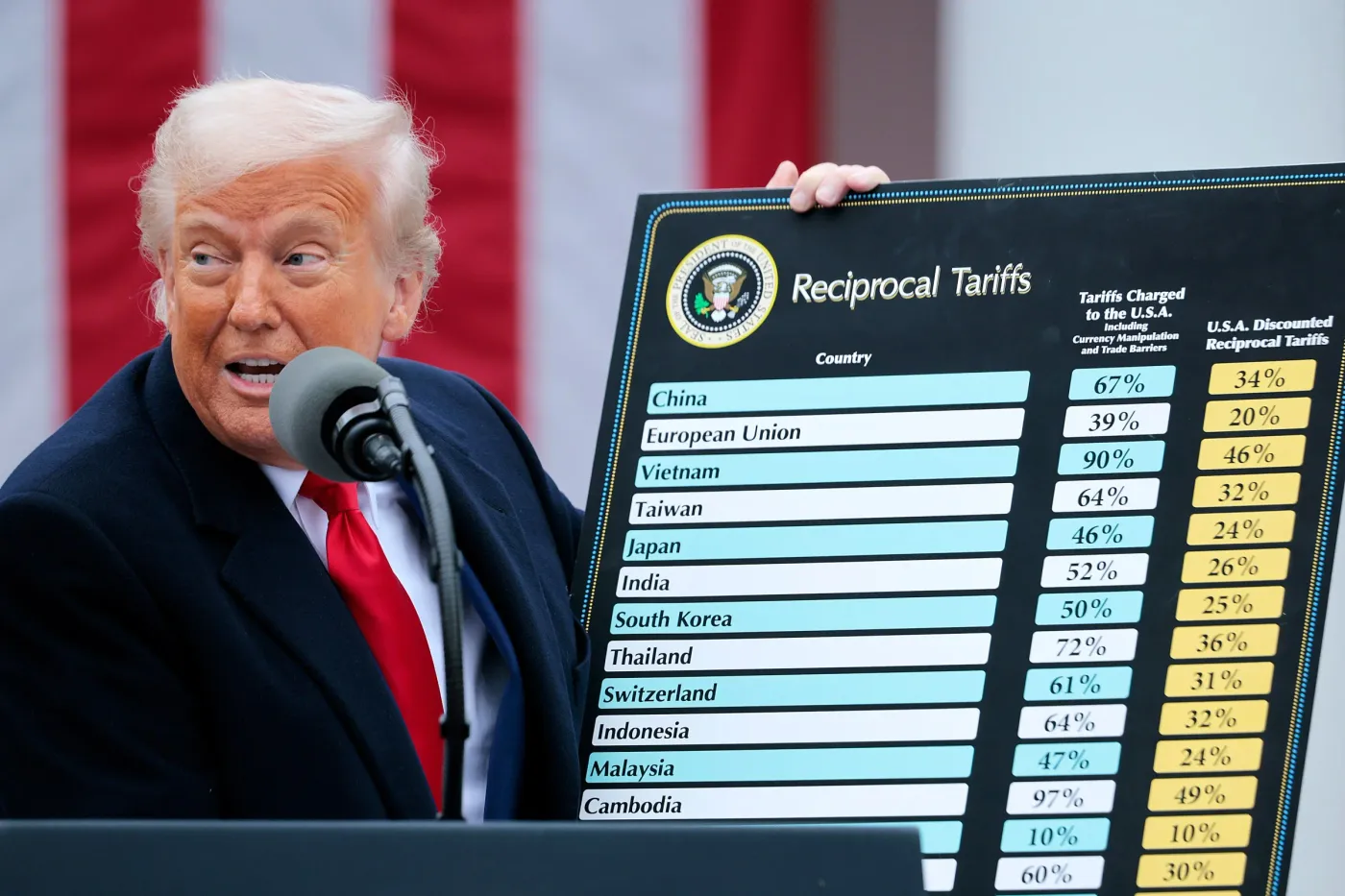
On April 2, 2025, President Trump signed Executive Order 14257, imposing a 46% reciprocal tariff on Vietnamese goods — the highest rate among major US trading partners. The VN-Index plunged nearly 8% in a single session. Investors dumped textile, wood, and seafood stocks — sectors expected to bear the heaviest damage.

The worst-case scenario at that time envisioned a 20-30% decline in exports to the US, supply chain disruptions, and mass layoffs in manufacturing. One year later, reality has played out entirely differently.
The Numbers That Surprised Everyone
Vietnam's exports to the US reached $153.2 billion in 2025, a 28% increase year-over-year. The bilateral trade surplus hit a record of nearly $134 billion. Full-year 2025 GDP grew 8.02% — the highest in three years.VietnamNews
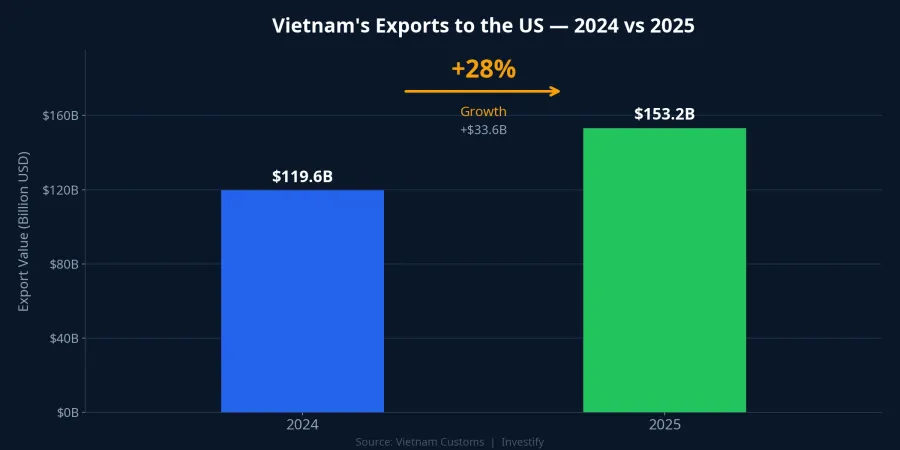
This paradox has three core explanations. First, the 46% tariff only lasted about four months before Vietnam negotiated it down to 20%. Second, businesses accelerated exports in the first half of the year to "beat the tariff," creating a front-loading effect on orders. And third — perhaps most importantly — the supply chain shift from China to Vietnam didn't slow down but actually accelerated, with registered FDI in the first eight months of 2025 reaching $26.1 billion and 759 new manufacturing projects, up 40%.JTM Asia
Capital Flows Are Diverging Across Sectors
The overall picture is positive, but capital flows have diverged sharply across export sectors. This is where investors need to look beyond the headline numbers.
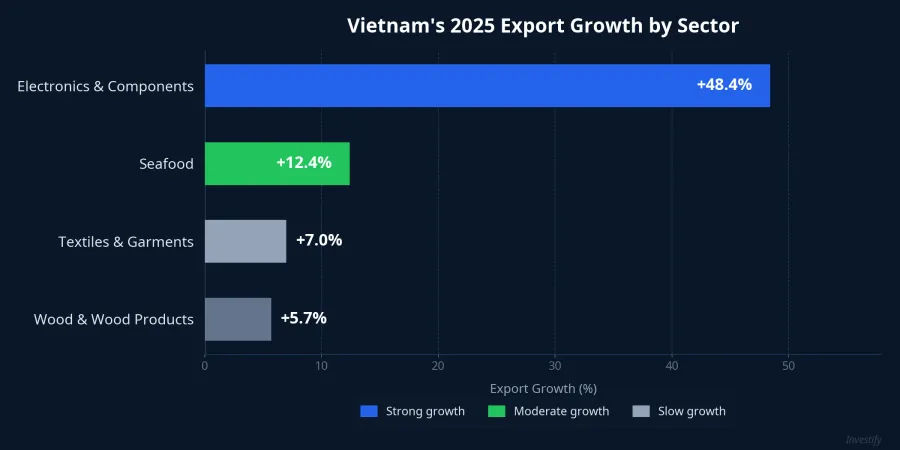
Electronics was the standout star, surging 48.4% to $107.7 billion. Apple continued expanding AirPods and iPad production in Vietnam, while Samsung maintained heavy investment — cementing Vietnam's position as Southeast Asia's leading electronics manufacturing hub.Vietnam Briefing Electronics stocks rose a median of 105% over the past year.

Seafood was an unexpected beneficiary, reaching $11.3 billion (+12.4%). Vietnamese pangasius replaced Chinese tilapia — which faced high tariffs in the US market — a substitution effect few had predicted.
Textiles and garments reached approximately $39.6 billion, up 7%, but the real story is margin compression. Compliance costs rose while unit prices were squeezed — the sector's median stock return fell from +20.8% in 2024 to -0.6%.
Wood held steady at $17.2 billion (+5.7%) but remained under pressure from transshipment investigations.
The Supreme Court Ruling — An Unpriced Variable
The last time a trade ruling caused this much disruption was perhaps the NAFTA litigation of the 1990s. On February 20, 2026, the US Supreme Court issued a 6-3 decision in Learning Resources v. Trump: the IEEPA does not grant the President authority to impose import tariffs.Wikipedia
The ruling invalidated all "Liberation Day" tariffs. Total IEEPA tariffs collected amounted to $175-179 billion.Sidley US Customs is building an automated refund system called CAPE, expected to go live by the end of April 2026.
For Vietnamese businesses, this is positive news: previously delayed orders may return. However, the Trump administration immediately imposed a new 10% tariff under Section 122 of the Trade Act of 1974 and is seeking to raise it to 15%.Vietnam Briefing The trade war hasn't ended — it has simply moved to a new battlefield.
Textile Stocks — Attractive or a Value Trap?
Looking at the valuation table, P/E ratios of 5-6x for VGT, MSH, and TNG appear extremely attractive. VGT reported 103.8% after-tax profit growth, MSH received a target price of VND 45,500 from ACBS with a 10% dividend yield, and TNG gained 46% in three months.Elibook
But these unusually low P/E multiples reveal that the market is still pricing in significant tariff risk. With margins compressing and trade policy subject to change at any moment, cheap valuations may not signal opportunity — they may simply reflect the actual level of risk.
Three Risks for the Second Half of 2026
Capital is flowing strongly, but investors must monitor three variables that could change the equation.
Section 122 tariffs currently stand at 10% and could rise to 15%. A key difference: tariff authority now rests with the US Congress, meaning a slower but less predictable decision-making process.
A record $134 billion trade surplus is a double-edged sword. The larger this number grows, the easier it becomes for Vietnam to become a political target amid US midterm elections.
Transshipment investigations are being tightened with 40% tariffs on transshipped goods. Companies that rely heavily on Chinese raw materials may face serious legal exposure.
The Bottom Line — Opportunities Exist, But Not for Everyone
The big picture one year after "Liberation Day" reveals the surprising resilience of Vietnam's export economy. The Supreme Court ruling is a positive factor that the market has not fully priced in. However, investors should not be complacent — export stocks are trading at attractive valuations, but they are only suitable for those who accept policy risk and are closely tracking US-Vietnam trade developments in the second half of 2026.