


The real risk lies where you least expect it — and Q1/2026 just proved that painfully in Vietnam's gold market. While many investors celebrated SJC gold's meteoric rise to a record 190 million VND per tael, just weeks later they watched 27 million VND per tael — over 14% of value — evaporate before their eyes. But the story doesn't stop at price swings. The police investigation of Bao Tin Minh Chau in the middle of the gold rush raises a serious question: is the market where millions of Vietnamese transact daily truly transparent?
From the 190 Million Peak to the 163 Million Bottom — What Happened?
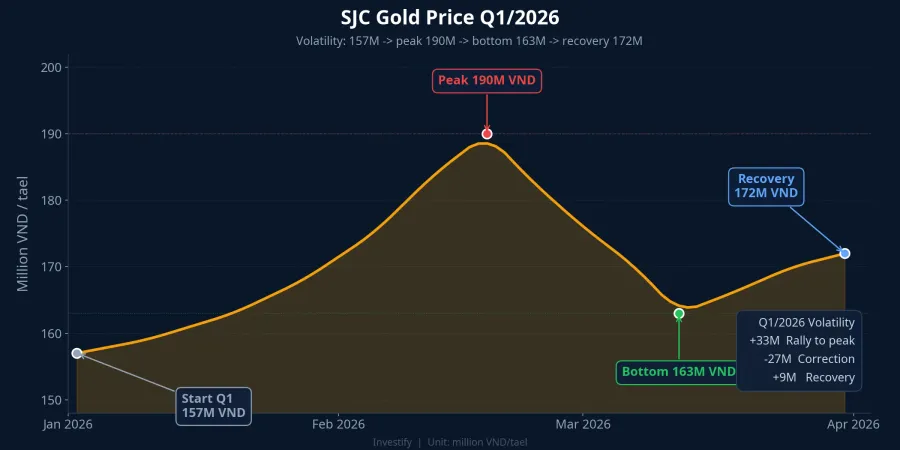
SJC gold bars hit a new record of 190.3 million VND per tael in late January 2026, then plunged to the 163-165 million range just weeks later, before recovering to around 170-172 million VND per tael by late March.Webgia The 27 million VND swing left many who tried to "buy the dip" catching a falling knife instead. What the reports don't tell you is that many retail investors bought at the 185-190 million peak driven by FOMO, and those who had to sell at 163 million lost 22-27 million VND per tael.
On the international stage, global gold followed a similar trajectory, breaking through the $5,000/ounce mark for the first time on January 26, 2026, climbing to an all-time high of $5,589/ounce before correcting sharply to around $4,433/ounce by late March.CNBC The annualized volatility of global gold exceeded 41% — higher than even the VN-Index. In other words, gold isn't the "safe" asset many believe it to be.
What Drove Gold to Record Highs?

Multiple factors converged to create the early 2026 "gold fever." Escalating Middle East tensions, particularly the US-Israel-Iran conflicts from late February, drove safe-haven demand sharply higher. Central banks worldwide continued buying gold in massive quantities — an estimated 585 tonnes per quarter in 2026.JPMorgan In Vietnam specifically, SJC gold faced additional pressure from unique supply-demand dynamics, with the gap between SJC prices and the converted world price reaching nearly 30 million VND per tael — a record premium reflecting the severe domestic gold bar shortage.
But who bears the cost of this premium? Retail investors — who buy SJC gold at "domestic" prices 30 million VND above the global equivalent. When prices correct, they face both the risk of global gold price swings and the risk of this premium narrowing at any moment.
The 7.5 Million VND Flash Crash and the Bao Tin Minh Chau Case

March 19, 2026 became a nightmare session when SJC gold and plain gold rings dropped 7.5 million VND per tael in a single day.VietnamNet Earlier, the February 3 session saw swings exceeding 10 million VND per tael — the quarter's most volatile day. For anyone who bought gold with borrowed money or household savings, each sharp decline like this can cause real damage to family finances.
Right in the middle of the market chaos, the investigation of Bao Tin Minh Chau added fuel to investor anxiety. On March 25, police seized numerous documents from Bao Tin Minh Chau's shop on Tran Nhan Tong Street, Hanoi.Tien Phong Previously, the State Bank's Chief Inspector had fined the company a total of 2.64 billion VND for violations related to anti-money laundering, gold bar transaction reporting, and selling gold above listed prices.VietnamNet
The case raises serious questions about the transparency of Vietnam's domestic gold market. Bao Tin Minh Chau is one of the largest gold brands, trusted by millions. If even this company has violations, is the current regulatory framework sufficient to protect gold buyers?
Gold Won, Stocks Lost — But Risk Exists on Both Sides
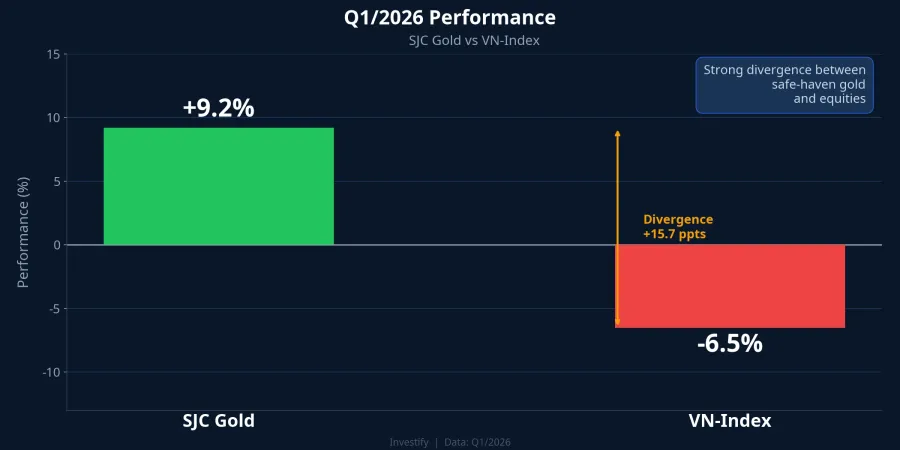
Looking at the full Q1/2026 picture, SJC gold gained approximately 9.2% while the VN-Index fell 6.5% — the two investment channels moved in completely opposite directions with a divergence of 15.7 percentage points. The VN-Index peaked around 1,850 points in January 2026 before correcting sharply to 1,672.8 points by quarter-end, losing over 9% from peak.Vietstock However, the final week of March showed recovery signals as the VN-Index gained 1.52%, with the March 27 session surging 28 points — the strongest in half a year.
Yet what the performance numbers fail to capture is the risk investors had to endure. Those who bought gold at the 190 million peak are sitting on losses exceeding 17 million VND per tael. Those who sold at the 163 million bottom missed a recovery of nearly 10 million VND per tael. And those who bought stocks at the 1,850-point peak are also down roughly 9%. Regardless of the channel, going "all-in" at the top delivers painful results.
Q2 Outlook — Bullish Expectations but Risks Lurking

Major financial institutions remain bullish. JPMorgan raised its gold price target to $6,300/ounce by end of 2026, up significantly from its previous forecast of $5,055/ounce.JPMorgan Goldman Sachs forecasts gold reaching approximately $4,900/ounce by December 2026, based on central bank reserve demand and expectations of Fed rate cuts.SBC Gold The $1,400/ounce gap between the two forecasts shows that even experts don't agree on the outlook.
The risks remain clear. A strong USD, persistently high interest rates, and profit-taking pressure could pull gold lower at any moment. In Vietnam, exchange rate volatility and gold market regulatory changes following the Bao Tin Minh Chau case are also factors to watch closely. As Q2 approaches, investors should carefully consider their allocation weights, avoid chasing the crowd when prices are already elevated, and always keep a cash reserve to seize opportunities during corrections. A diversified portfolio — combining gold, equities, and deposits — remains the safest strategy in these unpredictable market conditions.