
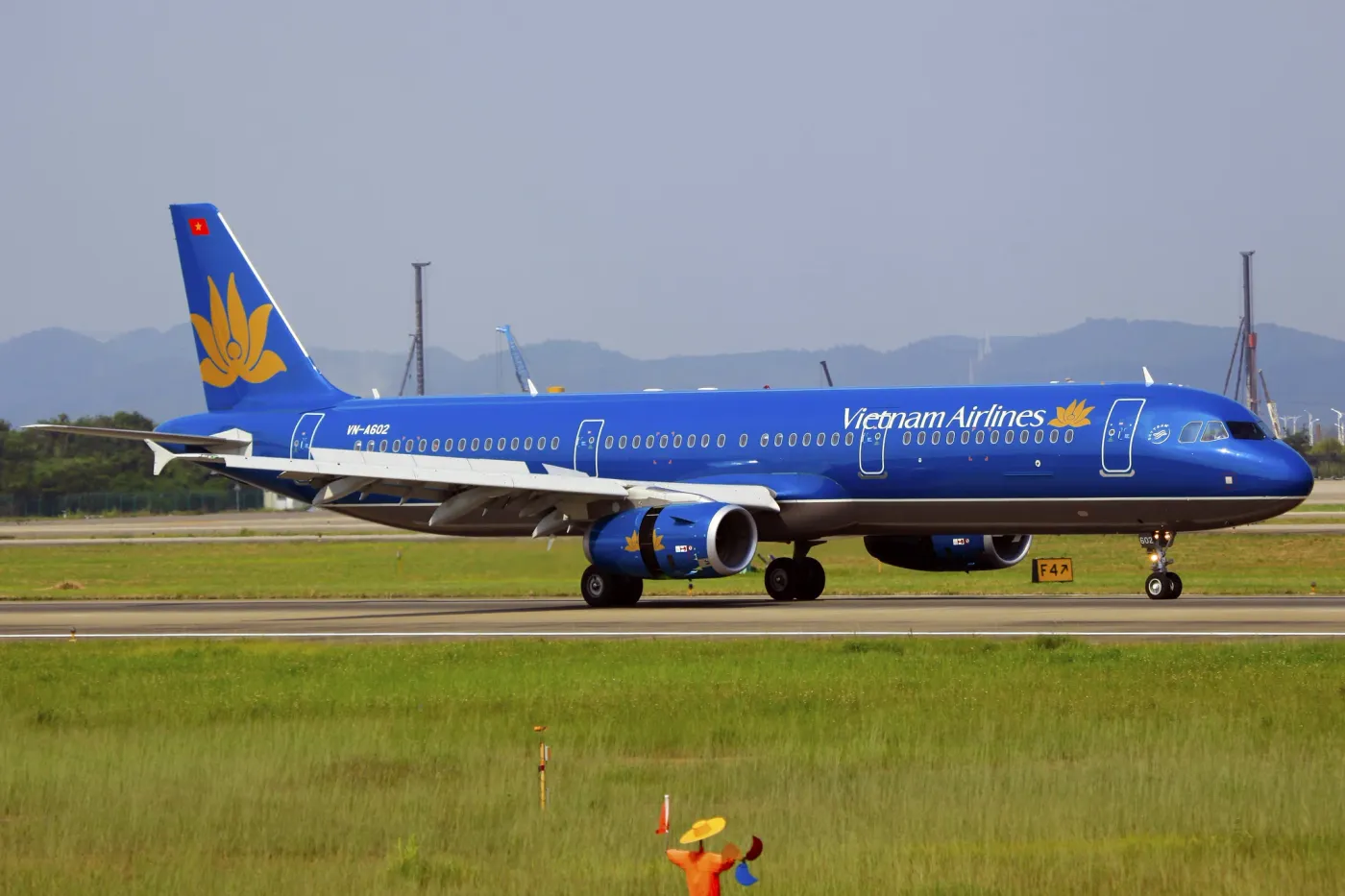

Looking at the numbers, Vietnam's aviation industry faces its most severe cost shock since the pandemic. Jet A-1 fuel prices in Singapore hit USD 234.34 per barrel on March 24 — the highest since 2022 — while fuel costs already account for 35-40% of airlines' total operating expenses.VietnamPlus
The direct cause is the US-Israel tension with Iran, which has effectively blockaded the Strait of Hormuz — the passage carrying over 20% of global oil supply. Brent crude surged past USD 114 per barrel, and the impact rippled through every flight route.

Jet A-1 Nearly Doubled in Two Weeks
The chart below illustrates the dramatic spike in Singapore Jet A-1 fuel prices. Throughout October 2025 to early March 2026, prices remained stable around the USD 120-140 range. But in just two weeks from March 10 to 24, prices nearly doubled, shattering every Q2 cost projection the airlines had prepared.
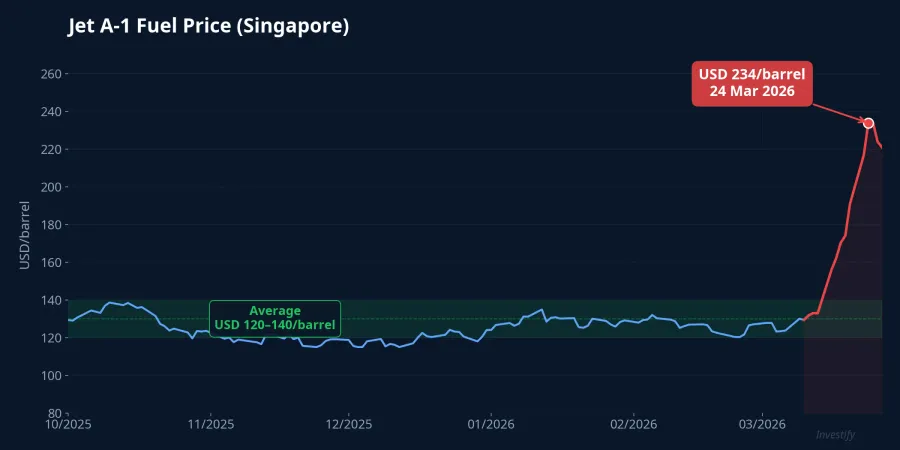
Notably, this price surge is significantly faster than during 2022. Back then, fuel costs escalated gradually alongside the Russia-Ukraine conflict, giving airlines time to adjust. This time, the shock arrived so quickly that both Vietnam Airlines and Vietjet were forced to react from a position of vulnerability.
Vietnam Airlines: Cutting Flights to Stop the Bleeding
Vietnam Airlines (HVN) chose a clearly defensive strategy — shrinking its domestic network to reduce losses. Starting April 1, 2026, the airline will suspend 7 domestic routes including Cat Bi - Buon Ma Thuot, Cat Bi - Cam Ranh, Cat Bi - Phu Quoc, Cat Bi - Can Tho, HCMC - Van Don, HCMC - Rach Gia, and HCMC - Dien Bien, equivalent to 23 flights per week.CafeF
This is only the beginning. If Jet A-1 stays in the USD 160-200 range, the airline plans to cut 700 to 1,700 round-trip flights per month during Q2 2026. Domestic routes bear the heaviest impact with 12-26% cancellation rates, while international routes see only 4-18% cuts.Thanh Nien
The logic is clear: preserve international slots to protect long-term positioning on high-margin routes, while sacrificing domestic operations where profit margins are already razor-thin and capped by fare regulations.
Vietjet: Raising Surcharges, Keeping the Network Alive
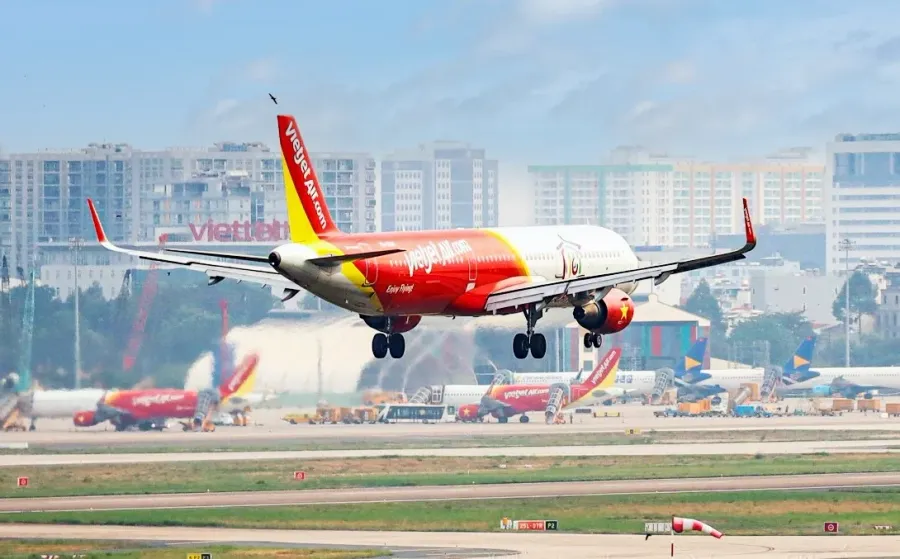
Vietjet (VJC) took the opposite approach — maintaining its network while aggressively raising fuel surcharges. On Korea-Vietnam routes, surcharges jumped from VND 500,000 to VND 1.57 million per ticket for flights to HCMC, Phu Quoc, and Nha Trang, and from VND 420,000 to VND 1.33 million for flights to Hanoi and Da Nang.Seoul Economic Daily
The airline committed to maintaining all 64 international routes, adjusting only frequency. However, Vietjet's low-cost model makes it difficult to pass the full fuel cost increase to domestic fares — where price-sensitive passengers dominate. This is the biggest risk of their strategy: if customers switch to other transport or postpone trips, seat load factors will decline rapidly.
Domestic Fuel Surcharges — A First for Vietnam
Vietnam's Civil Aviation Authority has proposed applying fuel surcharges to domestic flights starting April 2026. If Jet A-1 reaches USD 250 per barrel, the surcharge could rise to VND 680,000 per ticket for routes over 1,200 km.VTC News
This marks a rare instance of domestic fuel surcharges in Vietnam. With the summer travel season approaching, the fare increases will directly impact travel demand, particularly among budget travelers — Vietjet's core customer segment.
Comparing Two Strategies by the Numbers
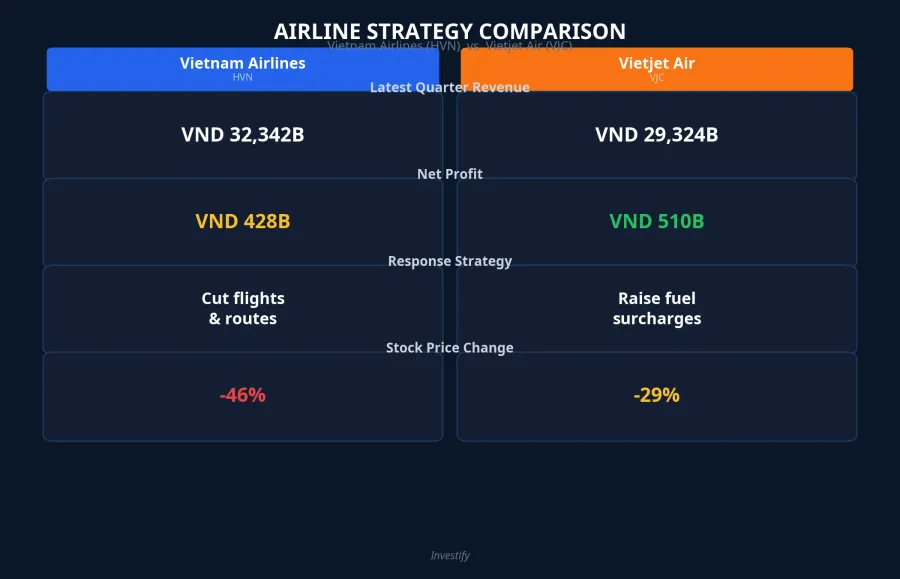
Looking at the comparison, both airlines posted similar latest-quarter revenue (VND 32,342 billion vs VND 29,324 billion), but Vietjet leads in net profit (VND 510 billion vs VND 428 billion). However, HVN stock has fallen far deeper — down 46% from its 52-week high compared to VJC's 29% decline.
Vietnam Airlines' plan to purchase 50 Boeing 787s was calculated based on oil at USD 90-100 per barrel — now entirely obsolete. Vietjet is more agile thanks to its lean structure and younger, fuel-efficient fleet, but thin margins leave little buffer if the crisis persists.
Investor Perspective
On the technical front, both HVN (VND 21,950) and VJC (VND 157,000) show clear downtrends: the 20-day moving average has crossed below the 50-day, with RSI lingering in oversold territory. The 29-46% discount from 52-week highs may look attractive at first glance, but short-term recovery signals remain absent while oil prices stay elevated and March CPI surged to 3.35%.
Three factors to monitor in April for reassessment: developments at the Strait of Hormuz and any de-escalation; additional government support measures beyond the VND 8,000 billion fuel price stabilization fund; and Q1 2026 earnings — particularly gross profit margins, as this is the metric that most accurately reflects how fuel costs are impacting each airline.