

The big picture reveals a troubling turning point: the Dow Jones has officially entered correction territory, Brent crude has surpassed $112 per barrel, and global capital flows are restructuring at a pace unseen since 2022. The last time this combination of rising oil, elevated interest rates, and geopolitical conflict appeared simultaneously was March 2022, when the Ukraine war erupted. The result back then: VN-Index lost over 30% in the following six months.
The question now is not "will the market decline?" but rather "where is the money flowing?"
Wall Street Suffers Its Worst Sell-off of the Year

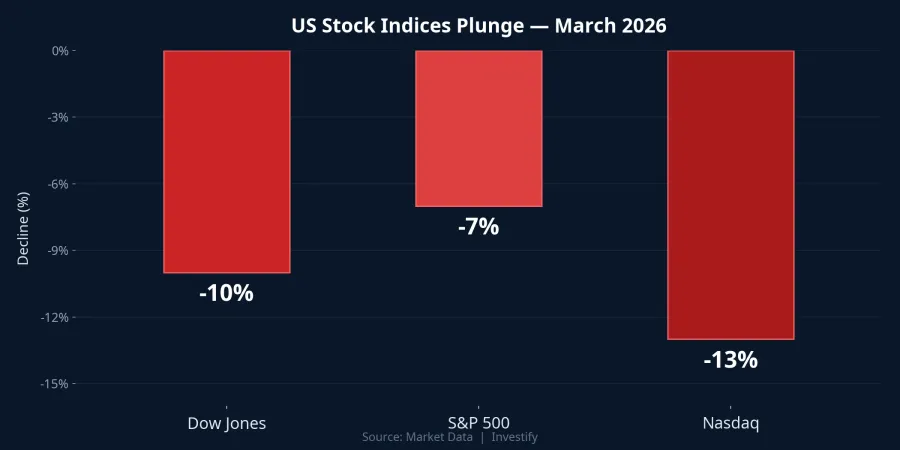
The March 27, 2026 session closed with the sharpest decline since the start of the year on US markets. The Dow Jones plunged 793 points (-1.73%) to 45,167, officially losing over 10% from its peak above 50,000 set in February — marking a technical "correction."CNBC The S&P 500 fell 1.67% to 6,369 — a 7-month low, while the Nasdaq dropped 2.15% and has now declined approximately 13% from its all-time high.
All three major indices lost more than 7% in March alone, with the S&P 500 recording its longest streak of five consecutive weekly declines since 2022.CNN This is not a routine pullback — it represents a structural shift in market expectations.
The Hormuz Crisis — Fuel for the Oil Price Storm
Capital is shifting for a very specific reason: the Strait of Hormuz. Iran continues to blockade the strategic shipping route that handles approximately 20% of global oil transportation. Two Chinese vessels were forced to turn back, and a Thai-flagged cargo ship ran aground after being hit by fire.CNN
The direct consequence: Brent crude surged 4.22% in a single session to $112.57 per barrel — the highest since July 2022.Fortune The oil price surge triggered a domino effect: US import inflation rose at its fastest pace in 4 years, the 10-year Treasury yield climbed to approximately 4.48%, and the prospect of Fed rate cuts has been virtually eliminated in the near term. In other words, "higher for longer" is no longer a scenario — it is becoming reality.
VN-Index: A Recovery Before the Storm
While Wall Street was drowning in red, VN-Index on March 27 posted an impressive gain of 28.17 points (+1.71%) to 1,672.8, with 253 stocks advancing and only 90 declining.Thoi bao Tai chinh Matching volume reached VND 20,309 billion, up nearly 16% from the previous session, indicating that domestic capital remains actively engaged. The real estate sector led the rally with numerous stocks hitting their ceiling prices.
However, investors need to understand the context: this recovery occurred before Wall Street's worst sell-off concluded, due to the time zone difference. Selling pressure from US markets has not yet been priced in, and Monday March 30 will be the real test. Historical data from 12 instances of Dow Jones declines of 10% or more during 2016-2026 shows that VN-Index typically loses 1-2% per session in the first 10 days after the shock.
Foreign Capital: Net Selling but Not Fully Retreating
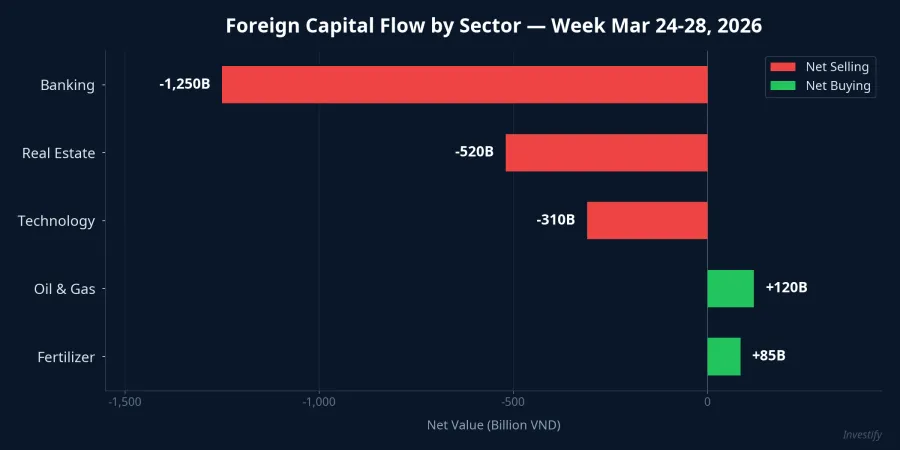
During the week of March 24-28, foreign investors net sold approximately VND 3,000 billion on HOSE, concentrated in banking, real estate, and technology sectors. On March 24 alone, foreign investors dumped VIC, MWG, VHM, and HPG with total net selling of VND 582 billion.CafeF
But the picture is not entirely negative. On March 27, foreign investors accumulated HPG (VND 125 billion), DCM (VND 96 billion), and VIX (VND 77 billion). Earlier, BSR received net buying of VND 156 billion on March 24. This shows that foreign capital is not retreating — it is rotating, shifting from interest-rate-sensitive sectors to those benefiting from oil and commodity price increases.
Winners and Losers
As capital rotates, the divergence between sectors becomes clearer than ever.
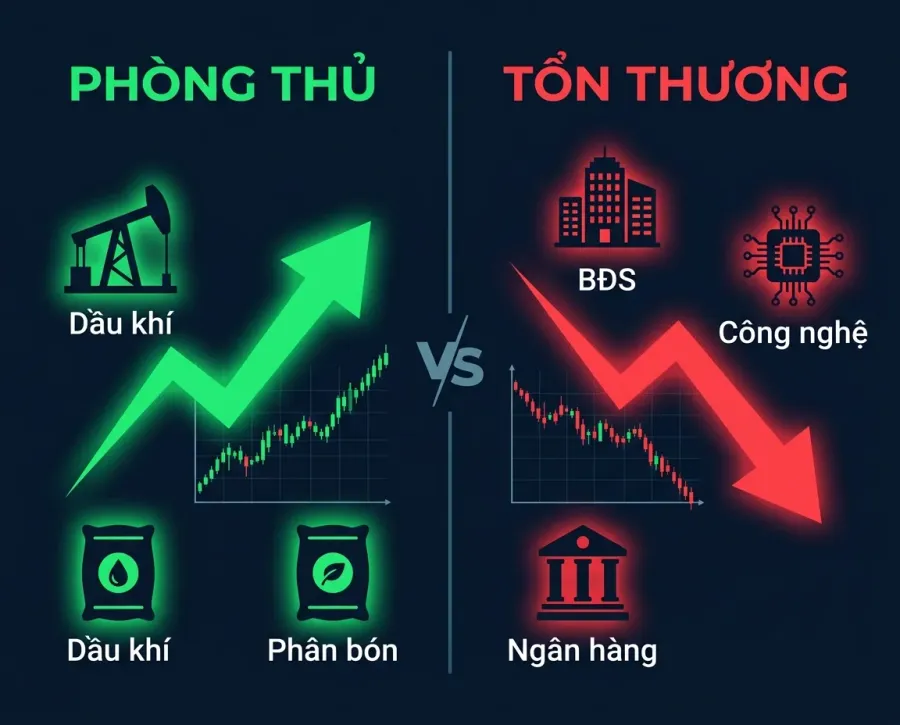
Defensive sectors — direct beneficiaries: Oil and gas (BSR, PVD, PVS) are the clearest winners with Brent above $110 per barrel. Fertilizers (DCM, DPM) are also rising alongside agricultural commodity prices, improving profit margins. Utilities (POW, NT2) with their stable cash flows will serve as safe havens when volatility increases.
Vulnerable sectors: Technology (FPT) is highly correlated with the Nasdaq — with the index losing 13% from its peak, discounting pressure on future cash flows is unavoidable. Real estate (VIC, VHM, NVL) faces rising capital costs combined with heavy foreign selling. Banking (VCB, BID, CTG) bears dual risk: widening risk-averse sentiment and continuous foreign net selling.
Next Week's Scenarios and Strategy
Base case: VN-Index opens lower on Monday March 30, testing the 1,640-1,650 support zone before finding equilibrium. This is a critical technical support level that held firm in February.
Bear case: If oil breaks above $115 per barrel or the Hormuz conflict escalates further, selling pressure could push VN-Index to the 1,600-1,620 range — the lowest since November 2025.
Recommended strategy: Maintain a defensive portfolio allocation, favoring oil and gas and fertilizer stocks. Avoid bottom-fishing in technology and real estate while foreign capital flows have not reversed. Three factors to watch closely next week: the Fed's messaging on its rate path, progress in international negotiations at Hormuz, and the trajectory of Brent crude — any signal of de-escalation could create short-term buying opportunities.