


What the reports never tell you — and what no technical indicator can warn you about — is that a single criminal prosecution can wipe out 30% of a blue-chip stock's value in just five trading sessions.
On March 17, 2026, the Ministry of Public Security's Criminal Investigation Agency launched a criminal case against Duc Giang Chemicals Group (DGC on HOSE), arresting Chairman Dao Huu Huyen along with 13 others.Tuoi Tre Three charges were filed: environmental pollution, illegal resource extraction, and accounting violations causing serious consequences.
But who is bearing the heaviest losses? Nearly 20,000 retail shareholders — those who believed blue-chips were "safe."Nguoi Quan Sat
5 Floor-Limit Sessions — VND 8 Trillion Evaporated
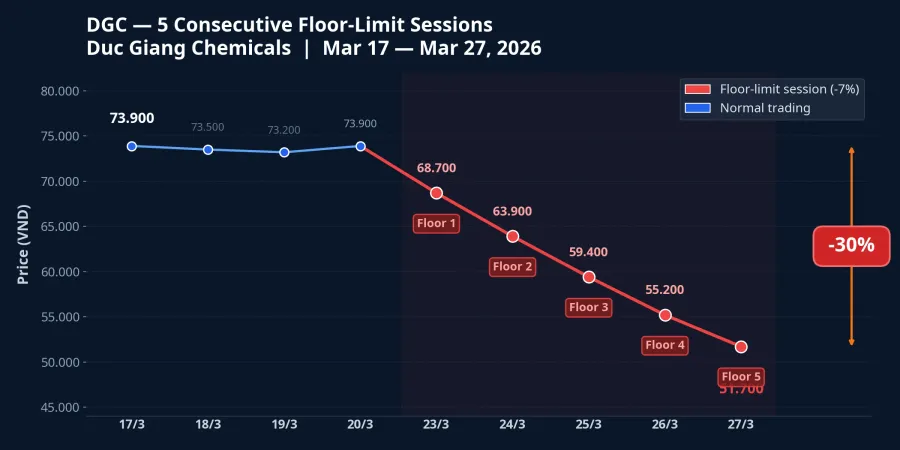
On March 17, DGC plunged from the VND 75,500 range to the floor limit. Sell-side queues exceeded 13 million shares at the close. And that was just the beginning.
The stock hit the floor limit for five consecutive sessions (March 17-23), falling from VND 73,900 to VND 51,700 — losing nearly 30% of its value.VietnamBiz Approximately VND 8 trillion in market capitalization vanished.
Where the Real Risk Lies
DGC was not only accused of illegally extracting hundreds of thousands of tons of apatite ore worth hundreds of billions of dong in Lao Cai. More critically, the company is suspected of concealing revenue and causing tax losses.Dan Tri Chief Accountant Dao Thi Mai was also indicted — a sign that the problem is systemic, not individual.

DGC is currently the world's largest exporter of yellow phosphorus (P4), accounting for roughly one-third of global P4 exports. The apatite mine at Mining Field 25 had to halt operations following the prosecution, threatening the raw material supply that the company had self-sourced at over 80%. If the mining license is not renewed by the end of 2026, DGC will have to import nearly all its ore, dramatically increasing production costs.
When Power Is Concentrated in One Family
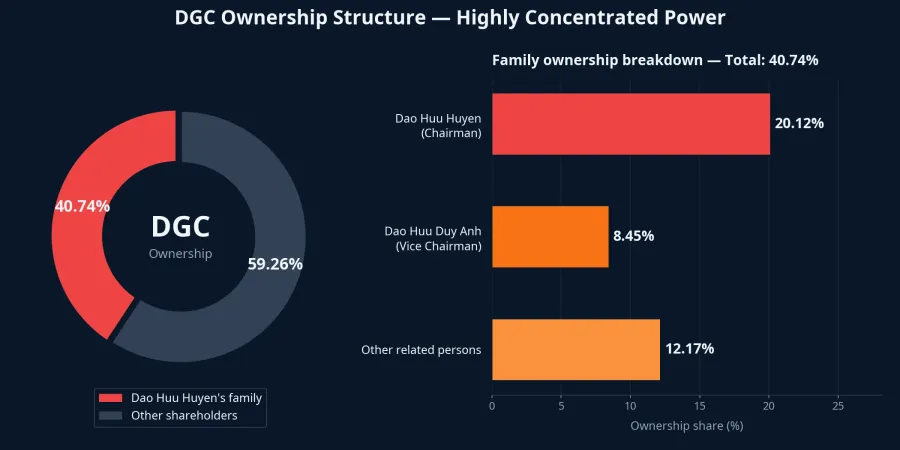
The Dao Huu Huyen family holds approximately 154.7 million DGC shares — equivalent to 40.74% of charter capital. Huyen alone holds over 20%. When the "command center" is arrested, the entire governance structure trembles.
On March 20, the Board dismissed the Chief Accountant and appointed Ms. Truong Thi Loan as replacement. The two remaining board members called an extraordinary general meeting for May 8, 2026, to elect three new board members.CafeBiz
The Margin Call Spiral — A Domino Effect
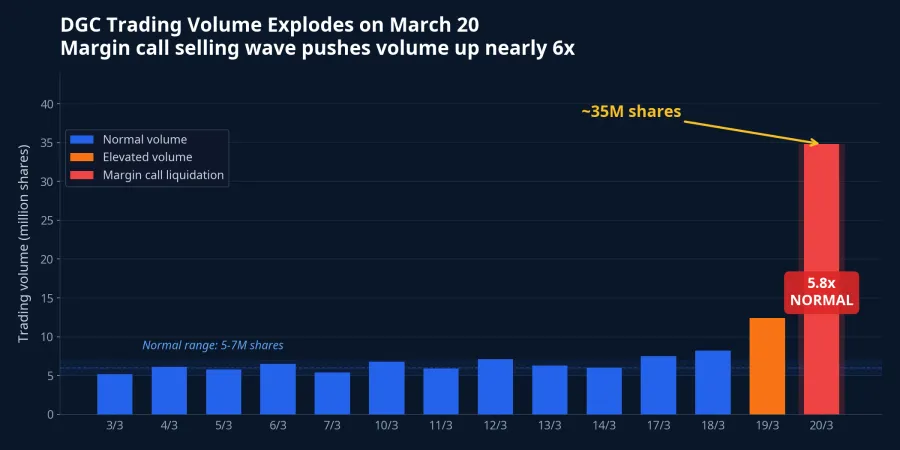
Mirae Asset Vietnam cut DGC's margin ratio from 45% to 0% on the same day, March 17.Dan Viet A wave of brokerages followed suit, triggering a vicious cycle: margin investors were forced to sell, pushing prices lower, which triggered more forced selling.

On March 20, nearly 35 million shares were matched — almost 6 times the normal volume.
History Repeats Itself — FLC, SCB, Van Thinh Phat
This is not the first time the market has witnessed this scenario. When FLC Chairman Trinh Van Quyet was arrested in 2022, FLC stock crashed and was eventually delisted. The Truong My Lan case at SCB/Van Thinh Phat caused losses of hundreds of trillions of dong. The common thread: legal proceedings drag on for years, and retail shareholders suffer the most.
5 Survival Rules for Retail Investors
Legal risk is hard to predict, but it can be managed through discipline:
- Cap position sizes: Never let any single stock exceed 10-15% of your portfolio, no matter how blue-chip it appears.
- Monitor ownership structures: Companies where power is concentrated in one family carry higher governance risk.
- Check compliance history: Past penalties for environmental or tax violations are early warning signs.
- Cut losses with discipline: When legal news breaks, the first 1-2 sessions are usually your only window to exit.
- Don't bottom-fish on emotion: History shows that legal proceedings drag on — prices can fall much further after the initial shock.
The DGC case is a sharp reminder: in the stock market, no stock is "absolutely safe." Legal risk can strike at any time — and when it does, no moving average or valuation model can save you.